Sunday, September 20, 2009

Always Looking Up


Michael J. Fox astounds me because he has never given up despite his disease. I never got the chance to read Fox's first memoir, Lucky Man, but I did just finish his second memoir which is pretty new right now, Always Looking Up: Adventures of an Incurable Optimist.

I got to listen to this book on tape with Fox actually reading it himself, which I found extremely powerful. You could hear his emotion when times were tough and you could hear the lightness in his voice when moments were funny. The experience was pretty intense because it felt much more personal because I was actually hearing him discuss his problems.

Further, I didn't know too much about Parkinson's Disease anyway, so I got to hear some first-hand accounts of what it's like to live with this. I couldn't imgaine having to transform my life to the degree that Fox has. It's sad that he's had to make so many lifestyle changes to accomodate his situation, especially when he had to give up a television show he loved to produce and act on when he left Spin City.

I found it sad listening to Fox talk about leaving Spin City since he loved it so much, especially since it continued on without him. Charlie Sheen replaced him, which must have been hard to watch. But, it was hard for Fox to juggle his active television career and with taking his meds and controlling his shakes. He wouldn't be able to stop, once he was walking, and communicate with someone because he wouldn't be able to control his bodily functions. Cast members thought he was mad at them, and that's when Fox knew it was time to move on.

Also, I enjoyed hearing about Fox's personal life and how his disease affects his family. Fox tells a lot of stories about his wife and her acceptance of his decisions regarding his disease and about his children and how it affects them. A lot of focus was placed on their eldest son Sam and how he has viewed the disease.


But, I saw this book as Fox's second memoir on PD, and even though some of it was on PD, a lot of it was just on his life in general without dwelling too much on the effects of PD. A lot of the book was just on his family life and politics surrounding PD research and his organization. Perhaps Lucky Man deals more with Fox and dealing with PD, but Always Looking Up takes it a step further into his personal life and his life post-Lucky Man.

Fox even gets into some personal stories like how he went through September 11th. He was across the country, about to guest star on Spin City in California after being gone from it for a couple of years, and he heard about the attacks. His family lives, works, and goes to school in New York City, so he panicked. He cancelled being on the show and looked to travel back to NYC, but all flights were cancelled for weeks. So, Fox rented a car and drove across the country with a friend. Family counts more than other things.

Fox also details such personal incidences as travelling across the country with his son when he was young, experiencing the birth of his twin daughters, and experiencing the death of his oldest sister. His sister was hooked up on machines to keep her alive, and they had to make the tough decision whether they should let her loose or not. These moments are all intertwined throughout the memoir.

I also didn't know that Fox was involved in politics, an organization, and trying to advocate for PD research with stem cells. A significant portion of the book is dedicated to this facet. I like that Fox is using his publicity and his finances to not only help himself but help others like himself that are affected with the disease. I also learned, through his discussions on the organization, that Ali has PD too! You'd never think that such strong people could be hindered by something like this.

Overall, the memoir seems to be focused on his struggle with PD, but a lot of it had random details and stories just about his life, which I didn't mind too much. If you're interested in PD or about Fox's life, this book should interest you.

I saw there was a TV special on the memoir, but I missed it. What was it about?

So what do you think of Always Looking Up: Adventures of an Incurable Optimist?

Tuesday, September 15, 2009

The Soloist


The Soloist grabbed my attention right off the bat because it is based on a true story. Besides that, the film has two phenomenal actors in them who are extremely talented, Robert Downey Jr. and Jamie Foxx. With those two elements on my side, the movie did follow through.

I think it's interesting how many times the story of this man's life has been told. First, Steve Lopez discovered this homeless, talented musician on the street in LA, and he thought it would be a story. Working for the LA Times, Lopez wrote a few columns on this talented man, Nathaniel Ayers, which he eventually turned into a book. Then this book turned into a blockbuster movie, and now people are commenting on the book and the movie just like I am now. Isn't it interesting how many ways the same story can be told?

Basically, Ayers was a homeless man who suffered extreme bouts of mental illness. She is schizophrenic, which caused him to lose his spot at Juliard and land him on the streets. However, Ayers is extremely brilliant. He taught himself to play various instruments, and he can play them better than those who practice for years and years. It's an incredible story.


Lopez helps get Ayers off the streets and helped with treatment. He even starts playing again which really lightens Ayers' day. It's crazy to think about how generous Lopez must be to help out this homeless guy. I mean, yeah at first he wanted a story and that is a bit selfish, but he didn't need to push it this far. His life started to blur with Ayers's life. It's really inspirational.

I thought the movie was done pretty well. I just wonder how it really happened and what the two men look like. I did look it up afterwards, and they look pretty different, but what are you going to do? Two talented actors did a terrific job. I just wonder how accurate the movie is to real life.

I enjoyed the movie. I heard it might even be movie of the year, 2009. Is that true? It was good, but I don't know if it was that good.

So what do you think of The Soloist?

Monday, September 14, 2009

I Was Told There'd Be Cake


True-to-life essays really captivate me. It's my new favorite genre that I am just stumbling upon. After being fascinated by David Sedaris, Chuck Klosterman, and Augusten Burroughs, I am now fascinated with Sloane Crosley's new book of essays, similar to the aforementioned authors, called I Was Told There'd Be Cake.

I was interested in this book definitely because of the nature of the stories, but I was also into the fact that she's writing about her past and she's not too much older than I am. A lot of her stories deal with issues and pop-culture references that are totally my generation. And, I get her humor.

Crosley's essays are quite a range. She'll discuss items from her childhood and even creep up into present-day issues and matters. Essays range from the following topics: collecting My Little Ponies in "The Pony Problem," working for a witch in "The Ursula Cookie," losing her keys while moving out of a New York City apartment in "Fuck You, Columbus," being half Jewish half Catholic and her voyages at religious summer camp, volunteering at the butterfly exhibit at a museum in "Sign Language for Infidels," being nominated as a maid of honor for a distant high school friend in "You on a Stick," reminiscing back to old-school computer games like Oregon Trail in "Bring-Your-Machete-To-Work-Day," and dealing with crazy neighbors.

I Was Told There'd Be Cake was such an enjoyable read. Not only is Crosley entertaining, but she's wickedly funny. She makes some pretty incredible points on obscure topics while making you think all the same. The incidents portrayed are ones that we might get ourselves messed up in (like a horrible boss or being a maid of honor) while others are completely outlandish and strange. But, that's what I like about it. I could totally connect with certain essays while I was completely entertained with other stories that were so bizarre and out there from my life. She is an excellent and easy read.

I know essays can scare some people, but they're very fun to read. They're little disconnected pieces of life that are really quite memorable. I kept wanting to read more. I hope that Crosley is on the path to creating more works because this book was spectacular. This is a great read and I would highly recommend this book to anyone who needs a light read or needs to laugh a bit.

But, I think I missed the boat on the name of the title or the cover of the book. Maybe there were some missing essays on the audio tape I listened to. I loved listening to the audio tape because Crosley read it herself. It just seems so much more personal, and it's interesting and fun to hear the author's inflections and how the author tells the story, literally. Try it if you have the opportunity. Can anyone fill me in on the title or the cover?

Read this book! So what do you think of I Was Told There'd Be Cake?

Monday, August 31, 2009

The Fillmore


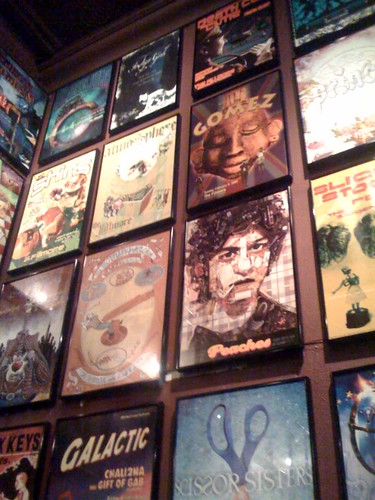
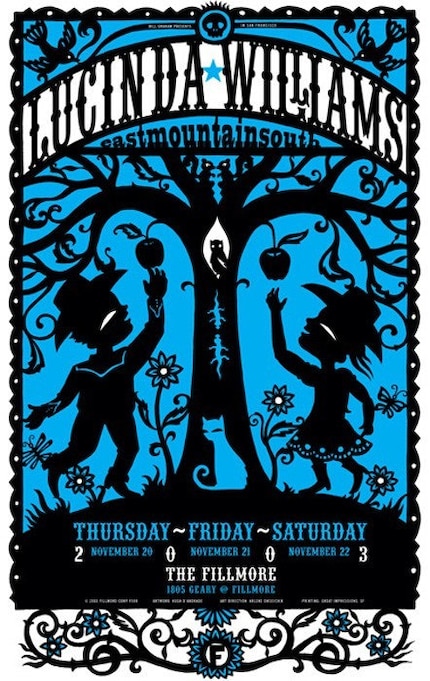
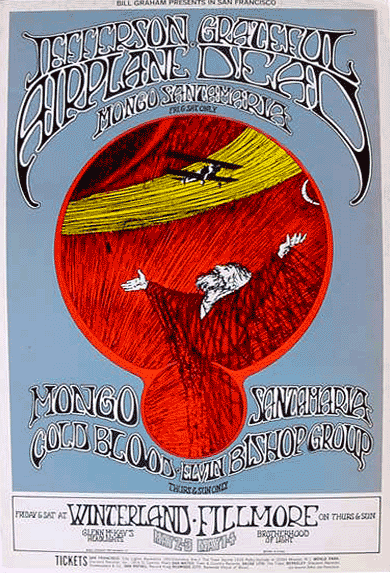
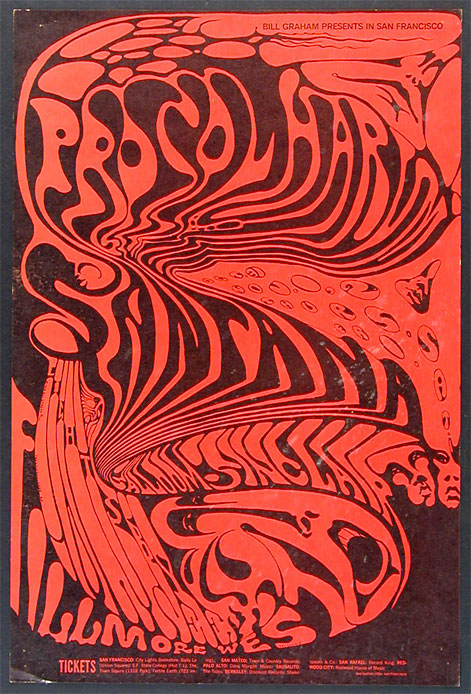
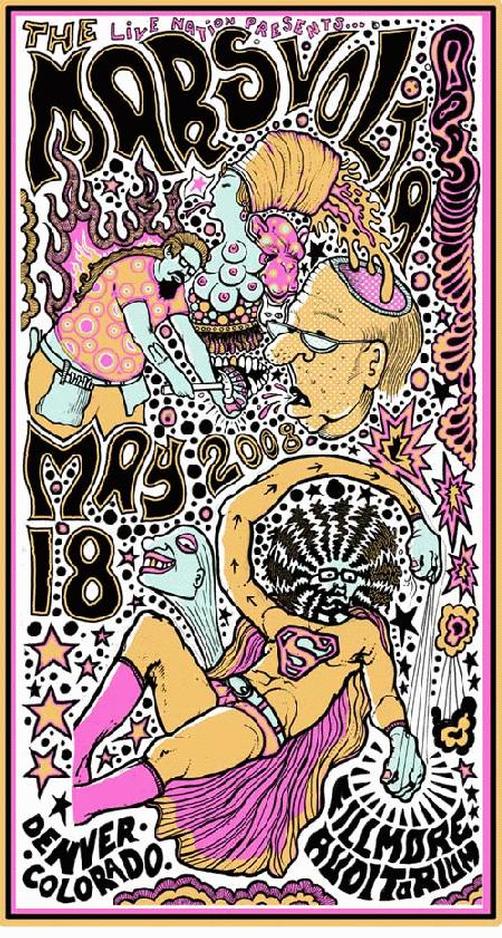
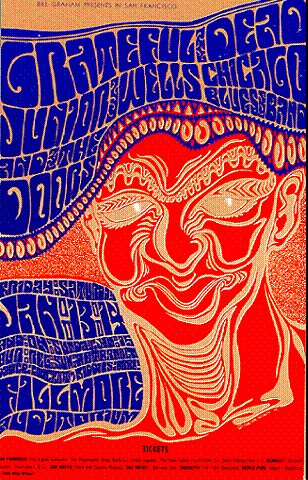
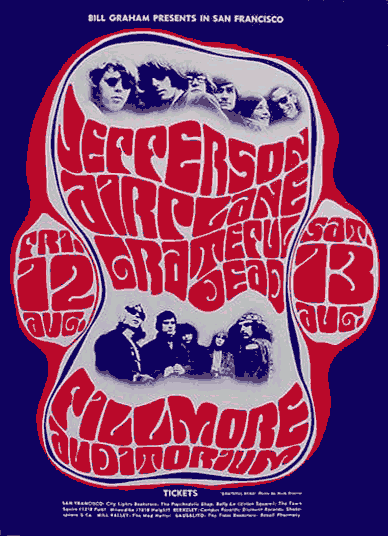
A few months ago, I was blessed with the opportunity to see a concert at the Fillmore in San Francisco. The venue is known for its small atmosphere, great bands, and excellent concert posters.

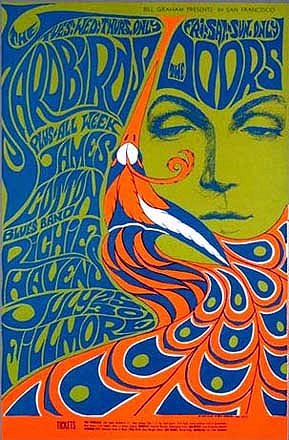
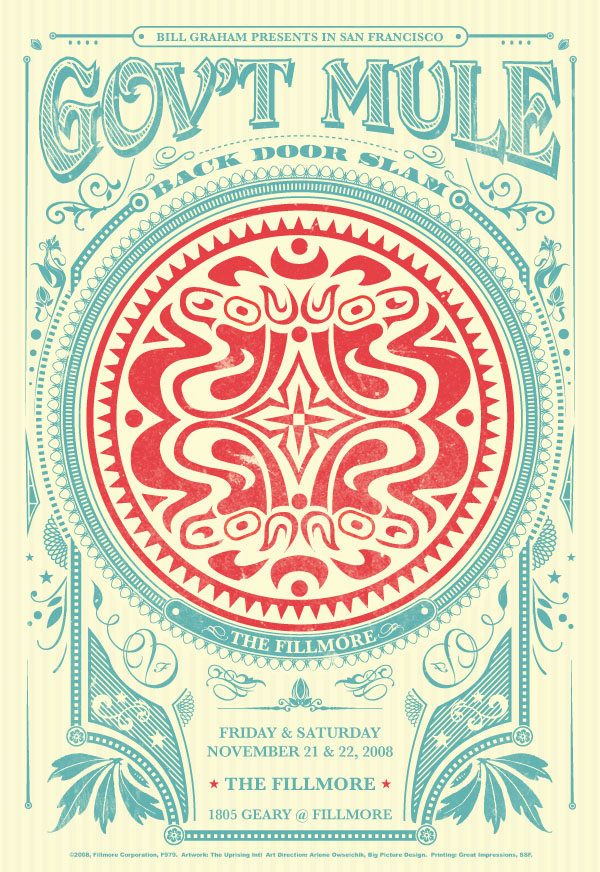
When you walk in, you are assaulted with incredible pieces of artwork, or at least they seem to be, in the form of concert posters. The entire building is covered in them as if some sort of wallpaper, except they are all framed. I could spend hours in there just gazing at all of the incredible bands that have graced their presence in this important venue. It's absolutely breathtaking not only to walk through here but to see a band perform here as well.

What I like about the venue, besides the decorations and interior designs, must be the small atmosphere. The venue has two floors, so you could either watch the band from the floor, which really isn't that crowded, or from the balcony where about five tables exist if you get there and set up early. Also, they if you want to stand on the floor, where we were situated, they have aisles cleared on each side so you can walk up and down from the front to the back. You don't have to push your way through; you just need to make it to the side where an aisle is literally patrolled by a worker (trust me, my friend was constantly being flashed with a flashlight to move her dancing self out of the way). It's also nice when places provide free water instead of charging way too much for it.


At the Fillmore, bands do two sets with an intermission. This is when we took advantage of the free water. When I went, we saw Railroad Earth and they were absolutely phenomenal. What most stuck with me was their violinist, and a female guest violinist who came on stage and jammed with him. They had a violin battle, as I like to call it, where they basically duelled with violins for who could play the best solo. I've never seen anything like it in my entire life. It blew my mind--they definitely left a good impression in my mind.

And, if the show sells out, everyone gets the poster advertised for free! We got one for Railroad Earth, which was absolutely sick. It got a little crumpled on its way back to New York, but I still think it's cool.

Anyway, below I would like to show some incredible posters from the Fillmore. I'm sure you've seen them before but maybe you haven't put the venue to the design. Check them out. And check out the bands!! What band of these would you like to have seen there?


So what do you think of the Fillmore?

Sunday, August 30, 2009

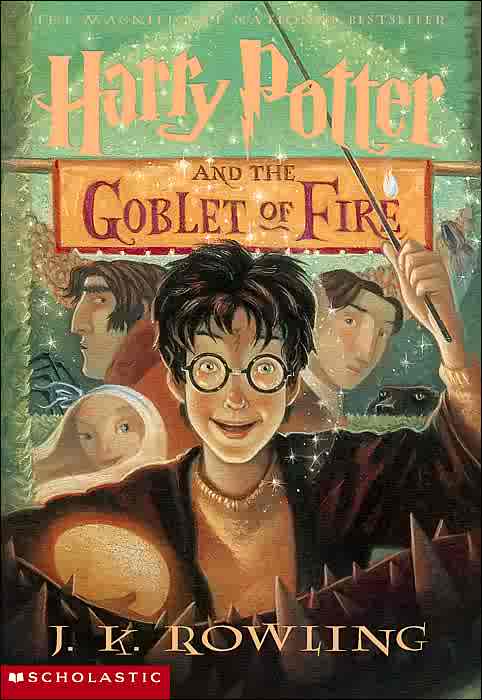
Harry Potter and the Goblet of Fire


Now, I'm cruising through these Harry Potter books for the first time, and I'm really quite enjoying them. I am fascinated by JK Rowling's ability to create a magical, fictional world with rules and characters and continuous plot development. It all makes sense and is extraordinarily interesting. I'm happy she's creating such a wonderful book series for adolescents and children!

I just finished the fourth book, Harry Potter and the Goblet of Fire, and I was impressed. Her books seem to get better and better as the series continues, but this could be because she doesn't need to establish characters or history anymore. She can just pick up where they left off and use what she's already created. She obviously will throw in a new character or two in every book, like Mad Eye Moody, Rita Skeeter, Ludo Bagman, and the Crouch family. Understandable. I like that there are constant new characters and the old ones keep growing and changing.

I like that this book broke a little bit from the same formula that Rowling had been sticking to for the first three books: start trouble at the Dursleys, get rescued, go to school, discover a conflict including Harry Potter that he must figure out clues to defeat, play Quiddich, fight with Malfoy, fight "the boss" and win (with the help of others), and return to the Dursley's. Zzz after a while.

Thankfully, this book broke a LITTLE from that formula. They included the Quiddich World Cup and the Triwizard Tournament, two sporting events that broke the repetitiveness a bit. The book also started with a scene between Voldemort and Wormtail, which I thought was a better way to hook readers at the start of the book rather than always relying on Harry waking up at the Dursley's to their maltreatment. We got it. No surprose. Unfortunately, the fifth book starts off that way. It's just getting to me I guess! Spruce up the creativity!

The Goblet of Fire starts romance brewing as well. Cho is introduced, and Ron starts to have little bursts of I'm-a-boy-and-don't-know-how-to-show-or-understand-love with Hermione. There's a dance, and emotions run high. Even Hagrid has a love interest! Ooo baby. The other books can only bring more now that they're fifteen! Woa now.

The ending was pretty well done. I liked how Cedric and Harry really helped each other win the tournament. Cedric's character really goes down in history as a good man for his final effort during the last task. I couldn't believe Cedric was killed though! I didn't see that coming. Now Cho can focus more on Harry. Yikes. The final scene was pretty cool though--establishes Voldemort's character, his return, and his followers, the Death Eaters.

The only thing with the final scene that gets to me is that it seems that, in the next three books, they probably will have similar endings to this one. Voldemort will continue to take down Harry, but Harry will keep slipping away with his questionable power over him. He'll need to keep escaping until the last book where he finally destroys him. It seems kind of obvious, but if each ending is Harry vs. Voldemort and Harry keeps slipping away to take him on in the next book, it just will get a little old. I hope it isn't so cookie-cutter of a formula on endings.

And, Harry didn't really win the tournament! The whole last task was fudged because Krum and Fleur were charmed, and then Cedric and Harry "tied," but Harry won because he died? That's not really fair. I mean, I think we all thought he would win since he's the golden child, but it seems like Cedric actually won. The other two COULD have won but were charmed. I don't know. It didn't seem fair to me.


And why are they trying to make Fleur's character so big? Both on the cover of the book and on the cover of the movie, they make her character stand out when it was so small. I know she's attractive, but come on now. I'm not into that either. They're better than this!

But, I really enjoyed the fourth book and I'm a little way into the fifth book, which is starting out pretty good. But Harry has quite a temper! I know all fifteen-year-olds and teenage boys go through this phase, but somehow I thought Harry was better than that. But, I guess the point of the story is that he IS human...

Anyway. After every Harry Potter book, I watch the movie. I wanted to vent my frustrations with the movie. Man, it was so different from the book! So many details were left out, so many plot points were out of order, and some characters weren't even included! Ludo Bagman didn't even appear. Ginny had some headshots, but she wasn't central, so why include her character and not Bagman's? No Bill. No Charlie. And, the whole idea of Mad Eye Moody being the antagonist in the movie is easily pointed to. Instead of discovering it for ourselves at the end, the filmmaker drops clues throughout, pointing to him as the obvious choice. I didn't like that at all. It took away from the mystery of the story.

Other details were out of place or weren't mentioned which really took away from the story. The last task was all off. Harry and Cedric pretty much battled and fought inside the maze which didn't happen. If anything, they were helping each other to win which makes Cedric's character more honorable. In the way he was portrayed here, he was kind of a brat. I didn't like it at all. Also, the way that Harry discovers certain secrets about the tournament didn't happen the way they were portrayed. Harry discovered the dragons from following Hagrid before meeting Sirius--not in the movie. Dobby gave Harry the gillyweed--not Neville. Small things like that irritate me. They didn't even bother showing the Dursley's! Harry just wakes up at the Burrow. Arg. I know there's limited time, but some things can't be THAT fudged! Then make two movies or make it longer! We're here for a reason; at least portray it right!

I felt like the movie was on fast forward and all I could do was sit and rack my brain on all the details they were missing. I had a hard time enjoying it, but maybe I'm being too critical. I know the book has to be massively condensed to make it into a movie, but the sacrfices they choose are not good ones to choose. They didn't bring up the elf plotline with Hermione, but I think that one was a good choice. That plot line bores me.

Anyway, I'm done rambling about my problems with the film, but I hear great things about the fifth movie. Seeing as though the movies are getting worse and the books are getting better, I hope it's not true. The movies need to do the books justice! Meh.

So what do you think of Harry Potter and the Goblet of Fire?

Saturday, August 29, 2009

The Colorado Kid


Another Stephen King novel for me, The Colorado Kid. I guess I'm starting off with some of his lesser known works, for my first was The Girl Who Loved Tom Gordon, and now I read The Colorado Kid published in 2005. King has an uncanny ability to write, as so many already know. His characters seem so real; they come alive off the page. He has a great way of describing things so that you actually can see it in your mind, even if it is a little creepy.

The Colorado Kid is a mystery novel, but it is unlike typical mystery novels. The Colorado Kid explores an unsolved mystery in Maine through a young writer named Stefanie or Steffi. She asks to older men at the newspaper if they've ever come across an unexplained mystery, and the two of them launch into the story about the Colorado Kid. The entire story is really a narrative of the two of them telling the story with Steffi asking questions every now and then.

Here is the mystery: Two teenagers discover a man on the beach very early in the morning in 1980. The man is in a jacket perched standing up on the beach with a piece of steak wedged in his throat. The cause of death is asphyxiation, and fish and chips are in his stomach when he passes--not steak. At the scene of the crime, he has no identification, just a Russian coin and a pack of cigarettes. The medical examiner determines that John Doe is not a smoker by his pink lungs. So what's up with the cigarettes and the coin?

A year earlier, a hotshot in town figured out that they should check the tax stamp on the bottom of the cigarettes to determine where they came from. This is where John Doe gets dubbed the Colorado Kid. A woman from Colorado calls to identify her husband who went missing years ago and abandoned his young son that he truly loved. Why would he run away if he loved his job and his family? The mystery keeps spiralling out of control.


Further, they question those who worked with him, and he was at work the day before he died. He would have had to jump on a plane directly after the last person saw him, on an elevator in the morning at work, take a private jet to Maine and then be killed or kill himself? The mystery further tangles.

By the end of the novel, nothing is really figured out. No more clues or answers are given. We are left with this tangle of a web without any sort of closure. At first I was a little mad because I thought that King was going to tell us how to solve this mystery, but he doesn't. He doesn't do what the typical mystery does, and that's why he's such an innovative writer. He makes us wonder. He does what the real world does: he doesn't solve the crime. Not every mystery and murder has that obvious solution. Sometimes it takes years to solve; sometimes mysteries never get solved. That's the way the world works.

I like this idea of storytelling that is ever-present throughout the novel. The act of oral storytelling is really getting lost as years go by. We watch movies, we read, but do we pass on oral stories? We do in a sense, at least looking at comedians, but not in the ways that we used to. I like that this story connects back to that oral tie that is becoming abandoned. I think it's pretty cool.

I was a bit disappointed without any closure, but I think it sends a more powerful, deeper, realistic message without having a real ending. It's more true to life. It makes the reader actually think and try to solve the mystery herself/himself. If you read a mystery novel, you might try to put it together yourself, if you're that bold or non-lazy, but most people would just read to find out. I like that you are forced to come up with some kind of idea because King won't give it to you. We need to be more creative thinkers and not have everything spoon-fed to us!

The only thing I don't really get, besides any closure on the story, is the cover. Is that Steffi? What's up with the 1970s cover? The cover doesn't represent the story at all. Or maybe I'm not looking hard enough. I didn't take Steffi to be that sexual. There isn't any romance or sex in the novel anyway! Why be so deceiving on the cover? And, the answer on the cover is NO!!!

What conclusions have others come to about what happened to the Colorado Kid?

What do you think of The Colorado Kid?

Friday, August 28, 2009

District 9


I didn't know what to expect with District 9. I knew that it had to do with aliens, but I didn't know anything else about it. Another alien movie, but this one is produced by Peter Jackson. I figured everyone would be talking about it, so I took a chance at the drive-in.

Watching this movie, I went through many different emotions. Disgust, anger, hate, sorrow, fear. The emotions were all negative, but I do think the movie was trying to communicate a larger message. I like the way it was filmed, as a mock documentary, and it was talking about everything after the fact, which I thought was pretty cool.

As I was watching it, I kept thinking how improbable the whole thing would be. Not necessarily the whole alien encounter thing but the response of humans. I didn't buy that humans would let the aliens come to their planet. Why would they let them live in a colony? I feel like it would be too big of a threat. I understand that they wouldn't accept them--we can't even accept each other for petty reasons like racial color, religious preference, or sexual preference. I think the movie is a great reason to point out our feeling of superiority among everyone around us.

I also thought it was quite improbable that both species could eventually understand their dialects after twenty years. How could we understand their language? They might not even have a language that is even close to English to be translatable. They made absolutely different noises. I just don't know if it would really ever work out. I mean, how does anyone learn a new language when you can't communicate anything to the other group?

So basically, in District 9, aliens come down to Earth and hover over Johannesburg, Africa for months. They do not come out. Humans eventually fly up and pry themselves into their spaceship. They are malnourished and need help. Humans send them down to a compound they call District 9 where they fence them in and provide them shelter and food. It is a heavily militarized area.


Twenty years later, their population is growing and they need a bigger compound. The people of Johannesburg are also growing quite tired of having them around. The plan is to ship them to a different compound 200 KM south, so the person in charge, a man named Wikus, goes door to door to give them eviction notices. Note that these aliens are given human names and identifications just like human beings.

Outside of the compound, humans try to deal food, weapons, and other pleasures to the aliens. It is considered the Nigerian black market. There's even inter-species prostitution. Yuck. The aliens really like catfood, so they try to sell them that as well. There are picketers and protesters outside the compound. The aliens have even earned a new derogatory nickname as "prawns." It is the equivalent of a racial slur.

The conflict in the story begins with Wikus is exposed to a very valuable liquid to the aliens. This liquid, held in a tube, can transport their spaceship back to their homeland where they all want to return. Unfortunately, Wikus starts to slowly turn into a prawn. The government tries to do tests on him as he is the only successful person to transform into a prawn. Others have tried by digesting parts of the aliens or having intercourse with them. There is even a special lab that does testing on them that the main alien, Christopher, stumbles over with Wikus when they try to secure the liquid.

Wikus eventually runs away from the holding facility because he gets his hands on some alien weapons. Alien weapons only work when an alien holds them (which is really genius), so he escapes and hides away. The only place where he is safe is when he is among the prawns. Christopher then discovers his problem, and they decide to go on a suicide mission to get the liquid. Christopher promises that if he gets his liquid, he will turn Wikus back into a human.

In the midst, the Nigerian black market tries to cut off Wikus's arm for their own military gain, Christopher and Wikus murder a lot of people, and Christopher and Wikus eventually return with the liquid back at Christopher's hut. Christopher says that he cannot change Wikus yet because he must return back to his homeland. He promises to return three years later to turn him back. Wikus gets angry, but in the end, Christopher and his son are able to fly away in the giant spaceship alone.


This is where I got all sad: Wikus slowly transforms into an alien and must live with the other prawns. He misses his wife terribly and leaves her little things outside her door to let her know that he is still alive and loves her. The movie ends without closure whether Christopher will return to save the other aliens, if he will return for war, or if Wikus will ever change back to being a human.

I liked the ambiguous ending. It also leaves room for a potential sequel. I think it would make a good sequel. I thought the whole thing was kind of dreary and sad though. It was horrible to see how we treated the prawns, but I guess I can understand it too. On one hand, I see that we must respect everyone, but on the other hand, I don't know how much I would trust them. They are so powerful and technologically superior that they could wipe us out in an instant.

I was kind of disappointed with how the aliens were physically created. They looked very human-like with two legs, two arms, eyes, and mouth pieces. It was very similar to the human body, and they even communicated in similar ways that were able to be understood. I don't know what else I would have preferred, but it just bared quite similar to humans.

What I didn't know is that it is based on a similar actual account that happened in South Africa, where it takes place. Check out its origination: "The title and premise of the film are inspired by historical events that took place in District Six, an inner-city residential area in Cape Town in South Africa under apartheid. In 1966, District 6 was declared a "whites only" area by the apartheid government and for the next several decades, 60,000 people were forcibly removed and relocated to Cape Flats, 25 kilometres away." I love the spin off. It's so very clever. It's easy to substitute something alien (an actual alien) in place of another group of humans to make a point. Brilliant.

District 9 was a bit raunchy and disturbing, but I think it brings up interesting points to talk about. How would you feel about having aliens drop down on our planet? How should they be treated? Do you even believe in aliens? Why would they come here? What could we learn from them? A believable tale or not?

So what do you think of District 9?

Wednesday, August 26, 2009

Cheri


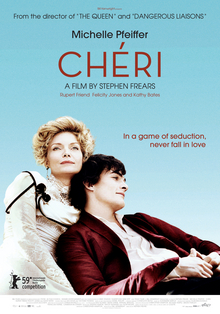
I saw an independent film tonight which really intrigued me. An old theatre near me plays really cheap movies, and I was interested in the title because Michelle Pfeiffer is in it. As an actress, she blows me away. She's absolutely phenomenal. And I was right again; in this movie, she was absolutely incredible.

Cheri is a movie that was once a novel. It is a European film that debuted at the Berlin International Film Festival. I can see why it wasn't that big in the United States, but I still do think it is worth repeating.

Cheri takes place in France and focuses on an old courtesan named Lea. Basically, Lea got rich by courting wealthy men who payed her to sleep with them for months or years. Lea is getting old, but she takes on one more prospect, a young man (18) who she knew when he was young named Fred. When he was young, Fred called her Nunu and she called him Cheri. They go by these nicknames throughout the movie.

Lea and Cheri meet up when he is eighteen and wild where he wants to run away with her. Lea takes it upon herself to court him and try to teach him how to be a man so he can be a good suitor. They have a lavish time together for six years. Then, Cheri's mother, played by Kathy Bates, fixes an arranged marriage. Lea and Cheri are forced to end their affair.

Cheri thinks he can just let it go, so he tries to marry this tight young woman. Lea takes it hard and runs away to stage that she is courting a new man. What Cheri didn't plan on was going mad with rage and envy. He comes home angry and is crazed as he waits for Lea to return. He stays in a hotel for weeks waiting for her. Cheri does take a new man but leaves him to return home when he hears that Cheri has separated from his wife.

Upon her return, Cheri gets back together with his wife because he thinks he can now rest since he knows that Lea is back in town. Unfortunately, he can't keep himself away for long. The movie ends on a last dramatic scene between the two when they make love and wake up in the morning. Lea decides that they will run off together and be in secrecy from now on. Cheri was planning on having a dual love life. They have this really in-depth discussion where Cheri reverts to being like his mother and he yells at her for being like her. He always loved her for being nice and humble and honest. So, Cheri reverts back to herself and tells Cheri what he needs to hear: he needs to forget her and be a man to his new family even though she deprived him of that in their relationship.


Cheri actually leaves, but a narrator discusses that Cheri went off to war and eventually shot himself because he could never love anyone else besides Lea. Lea did look very old in the end which was sad because I think Cheri started to notice it. It was such a sad relationship because they could never really love each other for very long. They lived without each other, still with a strong love, but couldn't have it because it wasn't acceptable. That kills me.

I can't believe the romantic taboos that were present back then. Everything had to be so clean-cut--that would never fly today. I'm happy that we have moved on to more open romantic relationships so people can be happy with who they love. They don't have to endure pain and be in relationships they don't want to be in. Some people still marry for show, but it's not the only option anymore. It's a great thing.

One thing that I did find interesting in Cheri was the gender role reversal. In their relationship, Lea wore the pants. She made phone calls and paid for them. She was the boss. She was the controller and the power force. She had a hold over him, and I think he liked that. Cheri was very flamboyant and beautiful. He dressed wonderfully and had gorgeous hair. He liked wearing her pearls and always curled up on him like a little boy. It's weird the way it worked out.

Even though the movie is tragic, it has some great themes and it was very entertaining. I really didn't know what to expect, but this was good. I liked being brought back to the early 1900s in Europe--it was gorgeous. Such a simple life. But it was also cool to see how courtesans were actually respected and made such a good life for themselves with the money they earned. It's so much different now!

Michelle Pfeiffer is looking old, but she is still so stunningly gorgeous. She is one of those women who have such natural beauty, and she still looks beautiful today. She was perfect for this role, and her acting was impeccable. She drew me in and helped me appreciate the film. I love the man who played Cheri too. I've never seen him, but he is so handsome. He was perfect for the part.

Their nicknames are perfect for each other too. Nunu is so childish, which still shows Fred's boyishness that he never lets go of. Cheri is so feminine, connecting back to the gender role swap. It's a clever addition to the story. It's a good story and a great indie film.

But anyway, what do we think of Cheri?

Monday, August 24, 2009

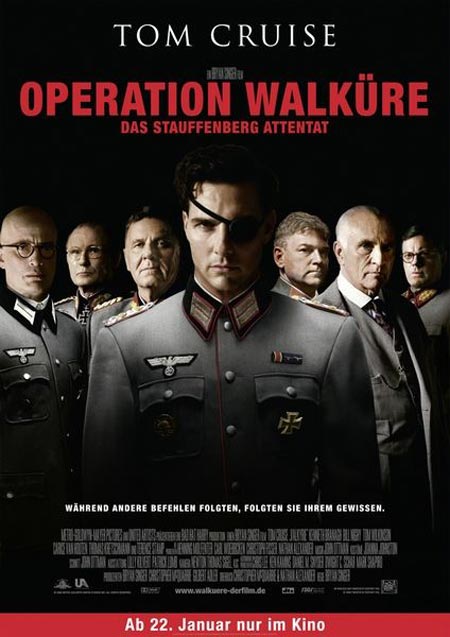
Valkyrie


Despite the negative reviews I heard, I still watched Valkyrie. World War II movies intrigue me, like the rest of this country, so I had to check it out. Just look at how many movies are made on the subject! Can't we just list WWII movies off the tops of our heads? I mean, even Quentin Tarrantino is making a WWII movie. That's when you know it's becoming a bit obsessive.

In any event, most people who spoke to me about the movie stressed its disappointing nature. I still watched it, and I really don't see why the movie was all that terrible. Honestly, I was pretty interested. It's one of those movies where you know the ending, so it's not really a surprise, but you still sit there hoping that somehow the course of history you know is wrong. But it's really not.

Valkyrie depicts one of fifteen assassination attempts made on Adolf Hitler by Germans to take him down in the Nazi Party. Von Stauffenberg, played by Tom Cruise, is the movie's protagonist. The movie is meant to bring his attempt to light since it was the one that almost worked and would have saved many, many lives. Von Stauffenberg gathers a team of military helpers to try to use Operation Valkyrie, a national emergency plan, to stage a coup to take over Berlin and assassinate Hitler in the process. Unfortauntely, the plan did not work and Hitler had all of the helpers killed for treason.

From a historical standpoint, it's a pretty interesting film. It's different from other World War II movies because it deals with the German perspective (even though it is probably twinged since it's an American film). Wikipedia offers a lot of perspective on the American critics take on the film and the Germans take on the film. Quite interesting. Apparently, the movie was pretty accurate. I mean, the whole thing was created because the writer felt that the Von Straussenberg story needed to be shared with the world. And now we all definitely know.


What I did learn from Wikipedia was the German people's reaction to the film. They weren't so mad about the content as they were with the filmmaker's selection of Tom Cruise as the lead role. They did not like his role in Scientology and basically put up a small fight about him leading the role. He was not fit for it, his religion is offensive, yadda yadda yadda. Even protestors set out to picket it. But, Von Straussenberg's grandson stepped forward and admitted that it was okay for Cruise to play the role. Others agreed later on as well since they saw his professionalism and realized that his popular role in America would draw a large fanbase. Interesting dispute.

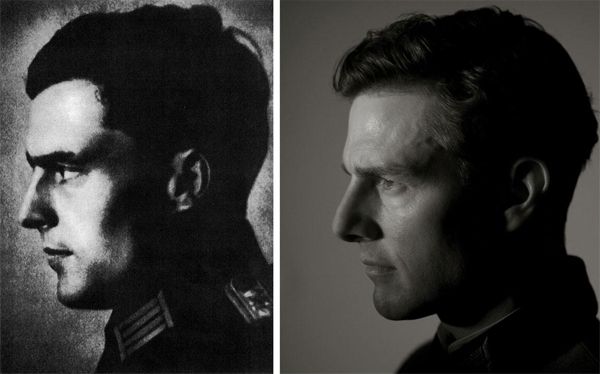
Overall, Valkyrie was very interesting if you like history, particularly World War II material. Cruise did a great job as Von Straussenberg, except I hate when he does those high-pitched screams. It sounds like my mom is yelling. I wish he had a more manly yell (better than "Show me the money!"), because it would add more to the character. It's just awkward. But despite that, he convinced me that he was the character and I thought he portrayed the story exceptionally well. Well done Cruise. And, he looks a lot like his character. It's kind of eerie!

I think the movie does send out a good message, especially since it's based on a true story. When you see a tyrant in your midst, do you go along because you fear for your neck or do you stand up to the cruelty even if it might mean that you die for what you believe? How do you want to be remembered as a people? Do you take a stand or sit by and watch? Is it just as bad to watch a perpetrator continue to perform ill than to commit the crime? Are you a part of the crime if you just stand by and do nothing? Think about those kinds of questions.

Valkyrie provokes those kinds of questions and perhaps applies them to our own lives. What kind of person do we want to be remembered as? Even though Von Straussenberg died, he is still remembered for trying rather than slipping into history unremembered. Without those like him, people don't take chances and horrible things happen. It's a great message to pass on even though he failed. We still learn from failure. It still can be motivational.

What do you think of Valkyrie?

Sunday, August 23, 2009

Elephant


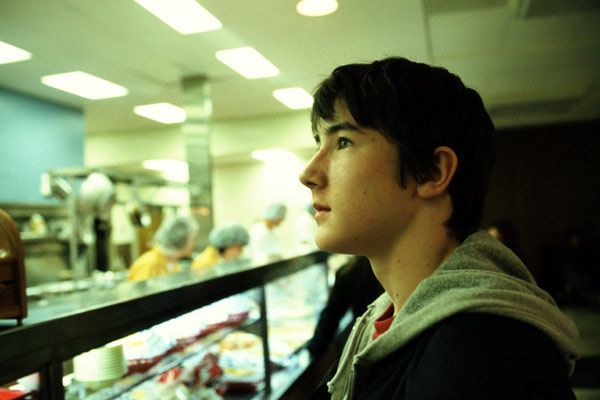
Movies on the Sundance Channel always intrigue me. The latest one I caught was Elephant, a movie written and directed by Gus Van Sant. This one intrigued me because of its unusual content, a movie about a school shooting. I found out later that this movie is loosely based on the Columbine School shooting, but it is only loosely based. Some is fictionalized.

This movie, as I later found out, is the second in a trilogy of his called the Death Trilogy. They obviously all revolve around the same theme of death. The first movie is called Gerry and is about two men stranded in the wilderness starring Casey Affleck and Matt Damon. The second is Elephant which is about a school shooting. The third movie is called Last Days and is based on the last days of the life of Kurt Cobain.

Elephant is quite artistically done. Van Sant's films always have this very indie, artsy feel to them. There is very little dialogue in this movie. It's more about character development, as the camera follows around each character on the day of the shooting. You'll follow one student who walks down the hall and passes another, and then later on in the movie you'll watch the day of the student who passes. It's an interesting way to do the movie as opposed to purely one-sided on the side of the shooter.

I liked seeing the different perspectives of the shooters and the victims. You watched the shooters get picked on in class, play piano, plan the shooting, practice shooting, and even make out in the school bathroom. Weird addition. What is the purpose of that? You watch the victims live their last days, and you really can tell how innocent and young they are to experience such a tragedy. One guy even tries to help, which is quite heroic, and he is sadly shot.


The movie chronicles the lives of these characters, and they are quite diverse. Anyone and anyone is killed in this movie, as the movie shows the lives of all of these different students in their days--a popular couple, a teen struggling with an alcoholic father, a gay student, two artsy students, a clique of uptight girls, a jock, and the shooters. I liked showing the different groups because it's one of the reasons that alienates these shooters.

It also scared me, watching this movie, how easy it is for them to pull off such a horrible feat. It was easy for them to score the weapons and carry them right into school. They studied exactly which entrance they could enter, and they studied which areas held the most students with little escape routes. And, what kills me the most is that they were able to practice and plan at home. Their parents were absent. This is what causes these things to happen in the first place!

The movie was a little slow, as the camera literally follows students walking for long periods of time. I could see how this movie would drag on a bit for some, but I found it different, thus interesting. I was waiting for that big moment where the shooting actually happens. It's nerve-racking because you know it's going to happen but slowly pray it doesn't, but you know better. That last build-up kept me hooked, and some parts were ambiguous as to deaths and escapes, but I thought it added some necessary flavor to the film.

The ending was a little odd. One shooter kills the other shooter (for what purpose?) and then goes into the freezer in the back of the cafeteria. He comes across the popular couple and corners them into the freezer. He sings "Eeny Meeny Miny Moe" to them as he points the assault rifles at their chests. Once he finishes singing, the camera cuts to black. Odd. I wanted to see what happened to this kid and how many were taken down in their path.


Elephant is based on and inspired by the Columbine shootings but was dropped with the tag to the shootings because he didn't want to hold too tightly to the facts of that shooting. A lot of the same threads were persistant in the movie and the previous school shooting. Acquiring the weapons, practicing, warning signs, easy access to shooting, being bullied in school. Smilarities.

What is really eerie is that this movie inspired a school shooting to occur, something that really turns the stomach. In 2005, 17 days after its release, a school shooting occurred after a kid watched this movie. It happened at Red Lake High School. The boy brought the movie over to a friend's house, skipped to the parts of the shooting, talked about school shootings, but showed no other signs of actually wanting to do it himself. Days later, he did it. Freaky.

I was kind of mixed on a movie about school shootings. Does this promote school shootings or does it try to show the root of the problem so we can solve it? I think it's a racy topic, but I like that it's being expressed in film because it's becoming a tragic and horrible problem in our country. The problem is that it's glorifying these shooters, which is what they want--attention. We can't give them that satisfaction because then it will create more and more shootings. It's a vicious cycle, but the media just can't help itself.

I still liked it though. The title confused me, but I thought "Does it mean not to ignore the elephant in the room?" That was my only thought, and I was pretty close. It's similar to another movie called Elephant which is a movie about violence based on religion. It is exactly titled for not "ignoring the elephant in the room, especially when it's obvious." I think it's very clever for a title. That makes a lot of sense in this country.

If the subject interests you, it's worth checking out. If you're into indie films or want something different, Van Sant is really talented. I do enjoy his movies because they focus a lot on the message and creativity. It's different from a lot of other blockbuster movies.

Enough said. What do you think of Elephant?