Friday, July 10, 2009

Costly Health Coverage


Recently, I read an article in The New Yorker with this central theme: hosptials view you as an ATM rather than a patient. Instead of focusing entirely on how to treat you the best way (even if it won't profit as much), they sometimes will offer additional treatments and procedures, just to jack up some costs.

This article, "The Cost Conundrum" by Atul Gawande, caught my attention. After watching Michael Moore's documentary Sicko, my ears were pricked. America's health care system has been a debatable issue in the past few years, especially as Obama has been suggesting some major changes in this past year. But, I think he's right. Something is definitely off and not working in our health care system.

From the article: "In Washington, the aim of health-care reform is not just to extend medical coverage to everybody but also to bring costs under control." Sounds good to me.

I think it's disgusting that health care practices seek profit from their patients in order to survive. Sure, it's a business, but their main goal should be to help people, not greedily empty their pockets. Everything is just so expensive too, nowadays. It blows my mind when other countries have better health policies--free health care!--and instead of shaking in their boots when someone is diagnosed with a terminal illness, they know they can get the best health care possible, and not because of discrimination. It makes the process all that more easy.

Why is it all about money?

"No one teaches you how to think about money in medical school or residency. Yet, from the moment you start practicing, you must think about it. You must consider what is covered for a patient and what is not. You must pay attention to insurance rejections and government-reimbursement rules. You must think about having enough money for the secretary and the nurse and the rent and the malpractice insurance."

But, this does not count for ALL hospitals and health establishments. Some are more oblivious to financial implications, and other see money as a way to improve what they do. With more money, they can receive more equipment, better doctors, better treatments, and more access to information. But, sometimes and maybe more often than not, profits are greedy and unnecessary, and that's what's bothering me. Doctors are meant to HELP PEOPLE, not strip them of their money like a thief.

I can't get Sicko out of my mind when I think of health care: I think of health insurance companies denying people because of just one yeast infection. I think of those same companies rejecting patients with long-term illness. I think of someone uninsured who had to fly from Florida to Canada in order to be treated. I think of high prices for inhalers on single working women who don't have enough money to raise their children and buy medication in order to survive. I think of ex-9/11 workers who don't receive government money to aide their health problems.

I thought America was the land of opportunity where men were free? They are not free of problems though. I know what democracy prides itself on, but this health care system is not fairly representing what America should be. I think it's downright embarassing when it comes to this health coverage scare. We're one of the "best" nations in the world yet we have one of the worst health policies in the world. Something is wrong with that!

This article touches on some of these factors, but its main focus is on the indulgence in charging customers. The article tries to get to the root of the problem: why is everything so expensive? Mainly, it focuses on a hospital in McAllen, Texas that has the highest health costs in the entire country. The problem is, their health care isn't any better than anywhere else, so why is it the most expensive?

Here are some interesting facts and quotations from the article to ponder:

"Our country's health care is by far the most expensive in the world."

"Spending on doctors, hospitals, drugs, and the like now consumes more than one of every six dollars we earn."

"The financial burden has damaged the global competetiveness of American businesses and bankrupted millions of families, even those with insurance. It's also devouring our government."

"Public health statistics show that cardiovascular-disease rates in the country are actually lower than average, probably because smoking rates are quite low. Rates of ashtma, HIV, infant mortality, cancer, and injury are lower, too." So why is everything so expensive? To compensate?


"We may be more obese than any other industrialized nation, but we have among the lowest rates of smoking and alcoholism, and we are in the middle of the range for cardiovascular disease and diabetes."

"Two economists working at Dartmouth, Katherine Baicker and Amitabh Chandra, found that the more money Medicare spent per person in a given state the lower that state's quality ranking tended to be. In fact, the four states with the highest levels of spending--Louisiana, Texas, California, and Florida--were near the bottom of the national rankings on the quality of patient care."

"In a 2003 study, another Dartmouth team, led by the internist Elliott Fisher, examined the treatment received by a million elderly Americans diagnosed with colon or rectal cancer, a hip fracture, or a heart attack. They found that patients in higher-spending regions received 60% more care than elsewhere. They got more frequent tests and procedures, more visits with specialists, and more frequent admission to hospitals. Yet they did no better than other patients, whether this was measured in terms of survival, their ability to function, or satisfaction with the care they received. If anything, they seemed to do worse."

"In recent years, we doctors have markedly increased the number of operations we do, for instance. In 2006, doctors performed at least 60 million surgical procedures, one for every five Americans. No other country does anything like as many operations on its citizens."

"After all, some hundred thousand people die each year from complications of surgery--far more than die in car crashes."

"To make matters worse, Fisher found that patients in high-cost areas were actually less likely to receive low-cost preventive services, such as flu or pneumonia vaccines, faced longer waits at doctor and emergency-room visits, and were less likely to have a primary-care physician. They got more of the stuff that cost more, but not more of what they needed."

"Health-care costs ultimately arise from the accumulation of individual decisions doctors make about which services and treatments to write an order for. The most expensive piece of medical equipment, as the saying goes, is a doctor's pen."

And consider this final scenario on health policy based on doctors' responses in El Paso, Texas:

"I gave doctors around the table a scenario. A forty-year-old woman comes in with chest pains after a fight with her husband. An EKG is normal. The chest pain goes away. She has no family history of heart disease. What did McAllen doctors do fifteen years ago?

Send her home, they said. Maybe get a stress test to confirm that there's no issue, but even that might be overkill.

And today? Today, the cardiologist said, she would get a stress test, an echocardiogram, a mobile Holter monitor, and maybe even a cardiac catheterization."

Maybe this is the major problem with health care:

"Providing health care is like building a house. The task requires experts, expensive equipment and materials, and a huge amount of coordination. Imagine that, instead of paying a contractor to pull a team together and keep them on track, you paid an electrician for every outlet he recommends, a plumber for every faucet, and a carpenter for every cabinet. Would you be surprised if you got a house with a thousand outlets, faucets, and cabinets, at three times the cost you expected, and the whole thing fell apart a couple of years later? Getting the country's best electrician on the job [...] isn't going to solve the problem. Nor will changing the person who writes him the check."

Overall, the points that Gawande makes are clear and troubling. It sickens me how the medical system works. It sickens me that man is motivated by money and will even have poor and middle-class people open up their tight wallets to dish out a healthy income that is many times multiplied by the one giving the money. It just doesn't make sense. It seems shallow and greedy, and I don't see why anyone won't do anything about it. I know it's opening a huge can of worms and it would cause a lot of change, and no one really wants to get involved in something this messy and drastic. It just bothers me. I can't stand this kind of behavior, and it sickens me how frequent this is happening.

What do you think of health care, Sicko, the facts here, or the article "The Cost Conundrum?"

Thursday, July 9, 2009

Lines on the Poet's Turning Forty


Turning forty is one of those difficult ages that humans face. It somehow marks that you are "old" now, and that you're turning into the second half of your life. People make a really big deal of it, sometimes throwing surprise parties, but other people might slip into some kind of middle-age crisis.

In any event, turning forty is an interesting point of life to examine. The New Yorker recently published a poem on this very topic. Let's see what you think of it.

Lines on the Poet's Turning Forty

by Ian Frazier

I.
And so, at last, I am turning forty,
In just a couple of days.
The big four-oh.
Yes, that is soon to be my age.
(And not fifty-eight. No way. That Wikipedia
is a bunch of liars.)
Nope, not any other age, just forty.
What other age can someone born in 1969 (and not 1951)
Possibly be?
(And please do not listen to my ex-wife, that sad, bitter woman in her late fifties.)
What does it feel like, old bones?
Yes, I have lost a step or two in the hundred-metre dash.
I accept these changes.
But if a guy stays in a published poem that he is forty,
As I am doing here,
It's obvious that it must be the age that he is,
Officially.

II.
Cattail down blows from the swamp like smoke,
Ice bares its teeth on the surface of the mud puddles.
It is fall--but not for me in any metaphorical sense,
Because forty, while not technically all that young, is hardly like "the autumn of life" or anything;
And also because Natalie Portman, the famous actress,
Is in love with me. And why not?
After all, there is not that much difference, age-wise,
Between a person who I guess is in her mid-to-late twenties
And a person who is just turning forty,
I.e., me.

III.
You walk across the room carrying a bouquet of phlox in your hand
("You" being Natalie Portman, the famous actress)
As a present for me on my upcoming fortieth birthday.
Come sit besides me, my dear,
And I will tell you about my previous thirty-nine,
Except for the year when I was in sixth grade,
Which is a total blank.
I do remember fifth grade, when we had Mrs. Erwin,
And seventh grade, when we moved to the new junior-high building;
But when I try to remember sixth--nothing.
Let us not mourn what is lost.
Sixth grade was probably not that great.
Now, and on into the serious years that lie ahead,
You and I will have each other.

IV.
An alert reader may point out
That we did not move into the new junior-high building during the 1981-1982 school year
(As would fit with my being in seventh grade and having being born in 1969)
But eighteen years earlier, in the school year of 1963-64.
This is baloney!
Whoever says such statements is wrong.
I think that when it comes to the details of my own life
My own world should be trusted over that of some random reader,
Thank you!

V.
Unfortunately, because of this business
About when we did or didn't move into the new junior-high building,
Natalie Portman's suspicions somehow were raised,
And she had a completely unnecessary "background check" run on me,
And then left me for Shia LaBeouf,
Who is hot right now.

VI.
This poem is becoming a disaster.
It happens sometimes--
I get into a poem, and the thing goes haywire,
And I don't know how to get out.
According to some nitpicker at the Ohio Department of Education,
Mrs. Roberta Erwin retired and left teaching entirely in 1967,
Two years before my birth.
Thus, the argument goes,
She could not have taught me fifth grade,
As I claimed in Canto III.

VII.
Look, I am turning forty, all right?
Let's just leave it at that.
Critics and people in the media who would ruin a celebration with this kind of "gotcha" behavior make me sick.
If you still doubt me,
Please be assured that this magazine has a rigorous policy of fact checking,
And all the information in this poem has been checked,
And directly verified with me.

VIII.
Well, it's going to be great being forty.
I am looking forward to it.
There are plenty of other beautiful actresses around;
I may also try out for the forty-and-over division
On the National Professional Rodeo Association Tour.
Recently someone asked me if I remembered when the name
Of Idlewild Airport in New York City
Was changed to J.F.K. International.
"Of course not," I replied.
"That was long before my time.
Back then I had not even been born."


This poem has a lot of personality, and instead of saying that when a poet turns forty, he feels X, Y, and Z or he then behaves like X, Y, and Z, the poet shows us with his words. I think that's more powerful.

Throughout the whole poem, it seems that the poet is struggling with coming to terms and accepting his new age. He doesn't want to be slapped with the title of being old, yet he is trying to embrace it. He WANTS to be okay with it, but when situations arise when it would affirm that he is old, he tries to shun that, as a natural reaction.

He also seems to be trying to hold onto his youth, especially with this random connection of Natalie Portman. But, as it happens in the poem, Natalie runs off with Shia LaBeouf, a younger, hotter man. Younger women might make older men feel younger, but it doesn't work out for the poet in this circumstance.

Even by publishing his age in this magazine (encapsulating it in time forever), he is even preserving whatever youth he has left. This is the youngest he'll ever be from this point on, and he seems to want to hold onto anything he has left.

He's also very concerned with facts and getting information straight, but his inaccuracy of answers (and his push to validate that they are correct) make us wonder: is he lying on purpose or does he truly not remember and/or forget the details? Forgetting is a sign of old age. Or, maybe he just wants to appear younger, so he fudges the details a bit to retain some of his youth. But, he is in desperate fear not to be discovered for these inaccuracies, AKA showing extreme paranoia. It's quite odd.

I like when the poet goes on, in Canto II, about the "autumn of life" and the frozen mud puddles. They are images that reflect his point of life. He is in the autumn of his life though. He isn't old enough to be in winter yet, but the leaves are slowly dying on his trees (in a metaphorical sense) or maybe he's in the last phases of summer. Depeends on his health and youthfulness.

Throughout the poem, the poet does weave in some words of truth and life lessons he has learned so far in life. This is another trademark of people when they get older. For example: "Let us not mourn what is lost." He also tells wild stories that you could imagine an older adult raving on and on about, maybe something not even that interesting to you. But, you learn about the person through how they tell the story and how they portray themselves.

One might even be interested to go back through the poem and read how many times the poet actually mentions turning forty (which is quite a lot). He keeps bringing it up or reminding himself, maybe to try to believe it himself or to just get back on topic as he keeps rambling on. Maybe we all have our own little theories for what that means.

But, it must be a strange age to turn, but I think this poem encapsulates it very well. A lot is said in this poem, especially since it is very long, but do you think there is a significance among the amount of Cantos? When I turn forty, I hope to look upon this poem to see how much my own thoughts on turning forty parallel with Frazier. We'll see when that day comes.

What do you think of "Lines on the Poet Turning Forty?"
Wednesday, July 8, 2009

Self-Control


An article triggered my attention in The New Yorker since I find the topic fascinating: self-control. I feel like Amercians definitely lack self-control. Especially with this newer, younger generation, everything is instantaneous. Information, food, and access can come at a moment's notice. No longer do we need to wait for many things, and if we do, there are lots of complaints. So, I think it's interesting to take a little time to ponder the idea of self-control.

Jean Twenge, author of Generation Me, might have a field day with this article since her book focuses on this newer, younger generation that receives quick results. We can text on our cell phones for quick answers we don't need, let alone those with Blackberries or iPhones who have much more control and access. If we want quick food, there is always fast food. If we want a plane ticket or a concert ticket, we log on to the computer to get it fast. We live in a fast world; we demand fast results.

That is why I think this article is so interesting: the research started in this article began before this so-called "Generation Me," before the technology we have today which eliminates much self-control.

The article by Jonah Lehrer is called "Don't!" which is pretty appropriate. The article begins with a study completed in the 1960s at Stanford University. Obviously, the study was conducted to test self-control of children and then follow them through their lives to see if this help/hurt them. The initial test placed each child in a room with an adult. The adult let the child choose between two treats, a marshmallow or an Oreo. The adult told the children that he was going to leave the room with the treat sitting on the desk. If the child waited until he returned, the child could receive TWO treats in return for the one treat. If the treat was gone when he returned, they would receive no additional treat. If they needed him to return in order to eat the treat, they had to ring a bell.

Most children struggled and simply ate the treat after the man left the room. Only 30% of the children could delay their gratification. Video footage shows children struggling, pulling at their hair, covering their eyes with their hands, kicking the desk, playing with the treat, etc. Many try to delay gratification, but they simply cannot follow through. Many didn't even bother to ring the bell before they indulged in their treat. If they're going to break the rules, why alert someone anyway? (I find it amusing)

The man only left the room for three minutes! I think it's sad that we need to be satisfied IMMEDIATELY and we can't wait any longer. What is that saying about us as a culture? It might be different if we were starving or living in horrific conditions, but most of us are not, especially those tested on the grounds of a major university. Yikes.


Some conclusions and results from the study:

"The initial goal of the expirement was to identify mental processes that allowed some people to delay gratification while others simply surrendered."

"The low delayers, the children who rang the bell quickly, seemed more likely to have behavioral problems, both at school and at home. They got lower SAT scores. They struggled in stressful situations, often had trouble paying attention, and found it difficult to maintain friendships."

"The child who could wait fifteen minutes had an SAT score that was, on average, two hundred and ten points higher than that of the kid who could wait only thirty seconds."

"Lower delaying adults have a significantly higher body-mass index and are more likely to have had problems with drugs."

Walter Mischel is the brains behind this study. Even before he was doing this study, he went to Trinidad in 1955 to complete a very similar study where he gave the children one day to hold onto a chocolate bar, and when he saw them the second day with the same bar, they would receive another bar. He tried to develop differences between races, but his results were inconclusive.

However, Mischel has a very interesting metaphor that I would like to share, kind of backing up and explaining his self-control research, in which he calls it interactionism:

"[Interactionism] concerns a car making a screeching noise. How does a mechanic solve the problem? He begins trying to identify certain conditions that trigger the noise. Is there a screech when the car is accelerating, or when it's shifting gears, or turning at low speeds? Unless the mechanic can give the screech a context, he'll never find the broken part."

In the same respect, Mischel is trying to get psychiartists to think like mechanics here. As he is trying to identify what makes people not have any sense of self-control, he needs to find what is "broken" in order to fix it. I think it's a very interesting metaphor that makes a lot of sense.

Techniques that Mischel found worked for maintaining self-control: learning metacognition (thinking about thinking), distracting the mind, practicing delay, pretending, establishing routines.

However, in terms of nature versus nurture, Mischel found that they are interrelated in terms of self-control. It can be a genetic factor, but nurture also comes into play. When Mischel gave a "delay-of-gratification tasks to five low-income families in the Bronx, he noticed that their ability to delay was below average, at least compared with that of children in Palo Alto. When you grow up poor, you might not practice delay as much."

The overall point and conclusion that Mischel leaves us with: "We're teaching ourselves how to think so that we can outsmart our desires."

Self-control is a fickle beast that I see way too much of in my life, especially when dealing with young adults. Students want the answers NOW--they have trouble when you ask them to complete an assignment that takes time. They want the words to be bolded in the textbook, they want to be given the answer, and they don't want to have to search too long to find it. It's becoming a difficult problem to tackle, especially in Enlgish, what I teach, when so much of their writing comes from their own opinions, judgments, and observations about literature and their worlds. It can be frustrating, but maybe they just need a little training and practice, as Mischel would suggest.

Self-control is harder than it seems, but in a country where the obesity rate and drug and alcohol abuse rate is rising, it's a hard battle to ignore. I think it's a very important skill to teach; many overlook it. Perhaps if there is more focus on it, we can see more positive results in other areas. It's definitely worth looking into.

So, what do you think of self-control or the article and findings from "Don't!"?

Tuesday, July 7, 2009

Forgetting Sarah Marshall


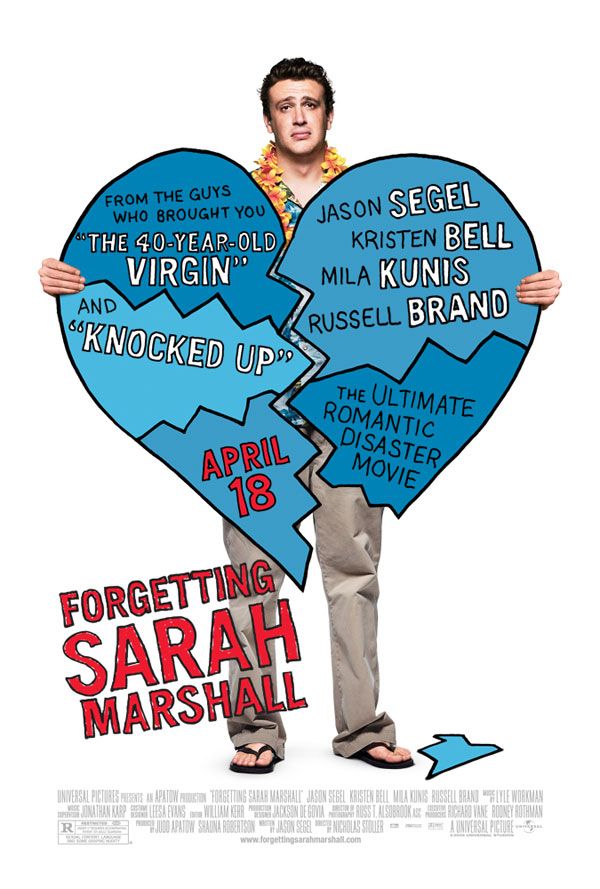
After seeing Jason Segel's second written movie, I Love You, Man, and enjoying it so much, I knew I had to see the first movie he wrote and starred in, Forgetting Sarah Marshall.

Segel impressed me with his unique style of comedy in his second movie, and I figured that his same humor and writing talents would come out in the first movie. I have to admit, I was a little skeptical and hazy on the first one, as I definitely judged a book by its cover and its cast. I remember walking by the movie in the movie store (I don't even remember it coming out in theatres), and it just looked like another dumb romantic comedy. I thought I'd be turning off the video in a matter of minutes. Well, at least I was wrong there.

The plot even sounded a little far-fetched to me, which it is, but it still was a movie worth watching. There was enough comedy streamlined with true-to-life situaitons about break-ups and dating that was very interesting to watch and think about. I really don't think that they would have been that intertwined on their vacations as they were, but then there really wouldn't be an interesting movie.

But, it is apparent that Segel has quite a talent for comedy script writing, and he's a pretty good actor too. I see big things for him; he could hold his own as an Adam Sandler or Ben Stiller. He's really good. The plot is interestingly and logically sequenced, he has interesting jobs for his characters to pursue, he has some interesting themes threaded in there--I think he will be successful.

After doing a bit of reading on the movie, I read that Segel included the naked break-up scene in the movie because something similar to that happened to him. I did notice that he was naked an awful lot in the movie--what was that about? I thought it was too much. There were awkward shots down to his member and he was just naked here and there. I didn't really understand and/or see the point. I mean, the movie starts and ends with him naked and walked in on by a love interest. Maybe the point was, as I discover it, that underneath everything, one girl didn't love him for who he was, and the other girl could see through it and loved him for who he was. Strange openers and closers to the movie, but I guess some people might have found it engaging.


I like how Segel characterized break-ups and relationships. He really showed how hard it is to get over somebody that you've been with for YEARS. I also like that he showed the male perspective, even if it might be a bit more dramatic than some men really take it. But, he proves some excellent points as his character wallows in his sorrows. He doesn't want to do anything, he doesn't want to do his job, he just thinks of getting back with her, he thinks of her with other men, he wants to get rid of stuff that remind him of her (which is everything) but he can't bring himself to actually destroy them (for what if they get back together?).

My favorite part in terms of this break-up idea is when he mentions to Bill Hader's character that everything in his house reminds him of her. The cereal holder reminds him of her because she always complained he left the cereal box open, so this would keep his cereal fresh. Now he has super fresh cereal! (He yells) But I like the overall point: even the smallest things will trigger memories of the other, and it's hard to rid yourself of those thoughts over the most mundane things. You almost have to reprogram your mind which is hard and takes time.

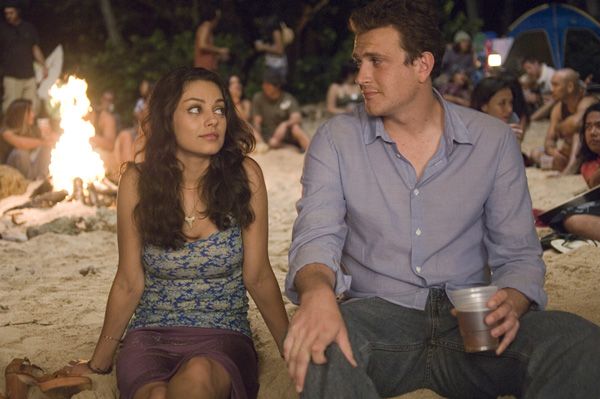
I didn't really enjoy that he had to get another girl in order to get over his past relationship. I mean, it added flavor and interest to the movie, but in terms of trying to teach a lesson, you don't have to relationship hop. People are allowed to be alone. Sometimes it's really healthy to be alone. Now, Segel does end up alone for a bit of time to complete his Dracula musical, but that's only because he was denied by his new love interest, played by Mila Kunis, until she came crawling back to him. I guess I'm not complaining more than I'm trying to pick out a point.

What I also enjoyed about the film was its cameos and guest stars. Besides the main four characters, other smaller characters included the following: Jonah Hill, Bill Hader, Paul Rudd, Kristen Wiig, Jason Bateman, Billy Baldwin, and Kenneth from 30 Rock. I enjoyed their side characters. They added a lot of flavor and personality to the movie. I especially liked Rudd's character--the forgetful stoned surfer who really tried to be authentic Hawaiian native but was really just a dude from the mainland. Good characters.

Overall, I think the movie was really well done. I definitely think that Segel is getting better with his movies, as I Love You, Man was definitely a bigger hit than Forgetting Sarah Marshall even though it wasn't a complete flop. I think he's gaining a wider audience and fan base, and that will help him out with his next few movies. He also seems to have a lot of Hollywood friends that can star in his movies, which make them all the more interesting.

What I like about Segel is that he writes relatable movies. He writes smart movies that one can laugh about because it parallels life so much. I love when writers will do that: they comment on the human experience, something we all can relate to, and add their two cents in a comedic way. It's brilliant. Good for Segel. I hope he keeps it up because he's going up at this point, as I see it.

What do you think of Forgetting Sarah Marshall?

Monday, July 6, 2009

Obscurity and Regret


I've come across another poem in The New Yorker that made me have a few reads and some pondering. You have to simplify to try to understand the premise; then after simplifying, then you can expand to understand the deeper meanings.

I like this poem because so much happens in just such a few short lines. I had to slow down a bit to piece everything that's going on. Let's see how you find the poem.

Obscurity and Regret

by CD Wright

The hand without the glove screws down the lid
on the jar of caterpillars, but the apple trees
are already infested. The sun mottles
the ground. The leaves are half-dead.
A shoe stomps the larvae streaming
onto the lawn as if putting out a cigarette on a rug.
It was a stupid idea. It was a stupid thing to say
the thought belonging to the body says to its source
stomping on the bright-green grass as it spills its sweet guts.


Everything in this poem seems to be symbolic. It seems that the tree (which is symbolic for something that was once treasured) is now past spoiled. The caretaker (the hand, the body) is trying to salvage what is left, but it's useless. He tries to get rid of the caterpillars with his jar, but then he notices the sun ruining the apples and the leaves that are clear signs of the dead tree. Larvae are also spilling out, and even though he crushes them, it's still too late to save the tree.

It's really a poem of death, the death of something once valued and now slowly rotted and spoiled. Even when we don't want something to die or be over, we still try to preserve it. Some people go in denial. Some people hold on to the very end. It's a stupid thing for the mind to tell the body (as the poem states itself), but, as humans, we do tell ourselves that. We hold on almost too long sometimes, unable to accept the fate. It's easier said than done--trust me. But, I think this pome is intelligent in how it depicts this message. We all can see the tree and understand its decay, yet we can't essentially visualize the tragedy of the death in such a concrete image. I like it. It's very smart.

This is also why the title is so appropriate: the human goes through obscurity (trying to piece it all together) and regret for the death (whether the person is responsible or not). Sometimes we are responsible, and sometimes the situation is just out of our hands. It's worse, as in this case, if it is the person's fault. It seems to be that the caretaker neglected care for the tree before its spoiling but can't accept his faults for letting this occur. Maybe this is more common than not because no one ever likes to accept his/her shortcomings or faults. The stronger person does. It's hard to come to this point.

A lot of key words in the poem also allude to death: guts, infested, mottled, half-dead, stomps, lawn (the ground). But, I think it's an interesting juxtaposition with these "dead" words when it ends with the "bright-green grass" which is such a lively image and connotation. Even though there is death and stupidity and mistakes, good can still come. Not all is lost. Life will come again. Life will even come from the death itself, as applied here. I always try to find the positive spin....

So what do you think of "Obscurity and Regret?"

Sunday, July 5, 2009

Disappointing Rolling Stone Covers

Let me premise this blog post by saying that I am a major fan of Rolling Stone. I look forward to every month's magazine because it offers the best, most interesting articles on pop culture. I am blown away by every magazine I get, hands down. But, in the past few months, I have to admit how disappointed I am with their choices of covers.

Every month, I slowly turn the cover over to reveal who is on the front. For the past few months, I have found myself extremely disappointed, even making faces and asking myself, "Really?" Come on now.

I understand that Rolling Stone likes to catch new and taw talent, and even cover older acts that are still hot (like the recent Bob Dylan cover), but I really don't agree with some of the recent choices.

The Hills. This looks like a different kind of magazine... And why would Rolling Stone back this kind of reality television series? It's trashy. It's MTV. It's disappointing.


The Jonas Brothers. I couldn't believe they chose to cover these guys. They are teeny boppers. They don't even have musical talent. Their songs are pop and predictable. They are lame and way too catchy. I don't see why Rolling Stone backed them. It's disgusting and appalling.


I'm sick of the Bush attention. I know that he wasn't a good president at all, but he's out of office. Great. I'm sick of hearing about him. Enough is enough!


In March, Taylor Swift. I know she's breaking records and she's young and new, but I've heard her music, and I don't find it at all impressive.


Then, horrifically, Gossip Girls. This was just as bad, if not worse, than when they featured The Hills stars on the cover. This looks like a dirty magazine, not a critically acclaimed one. Yuck.


Lil Wayne. I know he sold an unbelievable amount of records, and even though I don't like his kind of music, I don't respect him as an artist. You can still respect talent even though you don't like the genre. He was the most selfish artist I have ever seen live. I saw him last year at Virgin Fest in Maryland, and he threw a hissy fit beforehand, coming on an hour late, and going way over into the next band's time slot, The Black Keys. He made them run short because of his pride issue, thus screwing up times for the next few bands. And he wasn't even good at all. Bad choice.


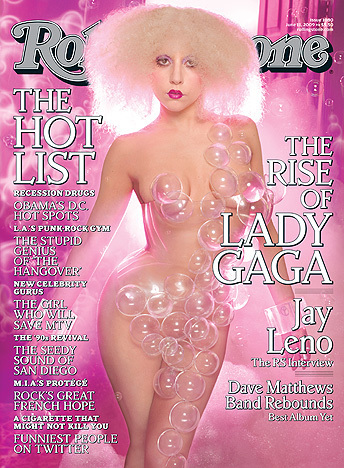
Lady Gaga? I was scared when I saw this recent cover. Not good music, scary photo.


Adam Lambert. Is he really that famous? Is American Idol still really that big of a deal? I understand that it's a big deal that he came out in the article, but it's not appealing to me at all. Wrong fan base for the Rolling Stone crowd. Excellent photography, though.


Jonas Brothers, again? Once was bad enough. Now we have to endure TWO wasted Rolling Stone covers? This isn't Tiger Beat or any other teen magazine. Maybe they're trying to appear younger and to a younger audience, but they're just not talented. They are a boy band with a pop sound that plays instruments in a mediocre fashion. I don't understand the hype. Maybe I would consider their talent if they had some, but their music is too pop-ish, nothing standout-ish, very easy to forget. This might be the biggest disappointment for me to date.


I hope they come up a knotch. Now not all of them have been bad. Some of them are mediocre or are tough to complain about. Others have been stellar in the past year (Bob Dylan, Sean Penn, U2, Green Day). Normally I get really excited each month, but this year has been more of a rollercoaster. It makes me nervous!

But, I anticipate that Rolling Stone will feature Michael Jackson on its cover. Just like when James Brown and Ray Charles died, I believe Rolling Stone will drop everything to cover his life as an artist. I expect he will be on the cover next month. I don't think that's way off. I'm sure others have predicted it too.

However, even though I don't always like who is featured on the covers, I still appreciate the photography. It's eye-catching and oftentimes genius. They have really talented photogs working at their magazine. I am always in awe of the way they craft their covers each month. Very well done in that respect.

I've had my two cents. Enough!

What do you think of Rolling Stone covers?

Friday, June 26, 2009

Stay Tuned...

I will be traveling for a week or so, so stay tuned for some more blogs in the very near future...

Michael Jackson


I know I will be the millionth person to blog/write about this on the internet, but I want to have a quick two cents.

My first reaction to his death was definitely shock; he seemed so young to die of a heart attack at age fifty. Part of me waited for multiple articles and tabloid stories on the mystery behind his "real death." But what I find the most shocking is that I knew of his death within thirty minutes of it happening. On the other hand, Farrah Faucet died the same day but we only heard about it because of Michael Jackson's passing. Weird world.

Michael Jackson is that person America loves to hate. I don't know if anything positive was published about him in the past ten years or more. We love to ridicule him on late night television and post horrible pictures and stories of him in magazines, let alone what airs on television. He was a public figure of embarassment, and it's kind of sad.

Now, I understand that he is also accused of molestation of young boys. I always wondered if this was true or if this was another publicity stunt. It's hard to tell nowadays. Some people just need money or attention. He could or could not be guilty; who knows. The media construes what it wants to be true. I never really judged him either way since I never really knew what was the truth. You can't always trust the media.

I bet he did have close relationships with younger boys, but I wonder if he really crossed the line. I think it's sad that he missed out on his childhood, thus constructing the Neverland Ranch, and he's always been trying to make up for it his whole life. Additionally, he has so many identity issues (hence the pigment and nose surgeries). If anything, his life is a sad tragedy, or was a sad tragedy and downfall.

Hence, once I heard he died, I was really interested to see how people would react. I wish I had polled people one week ago about Michael Jackson. I bet at least nine out of ten people would have said that he was a pervert or a psycho. Now that he's dead, people are treating him with so much respect, like the King of Pop and such.

Why do we pay so much respect to people once they're dead? Why didn't we show him this kind of respect when he was alive if we truly feel that way?

Those are my big questions around this death. When I went on Facebook or when I interacted with the public on the issue, people seem to be either one of two ways: they are either sad about his death because he was such a great public figure or they make crude comments and jokes almost happy that he is dead. There are polar opposite remarks. I just wonder what the positive side would have said one week prior to his death.


The reactions seem to be quite hypocritical, if you ask me. People are now making a big deal of him, but what about while he was alive? It's just a weird cultural, societal thing. We hate him when he's alive, but when he's dead he's a cultural icon? We are so full of it. We're so cynical. We're such hypocrites.

Now, what if Britney Spears died suddenly? We'd also make a big deal about her death, the Pop Princess. But, when she's alive, all we do is criticize her to death. We make her life (and we made Michael's) a living hell. Everything published about them was negative. Imagine living a life like that... But if Britney died, I'm sure we'd have the same reaction. I find it appalling and ridiculous.

I am also shocked at how news stations are covering this. NBC recorded over television shows just to cover his life and death. You'd think the president was shot or something. Who else would we make such a big deal out of their death? I'm just surprised that we are out of HIS life, because doesn't that set a precedent for other deaths? It wasn't THIS big when Ray Charles or James Brown died. I mean, they were big deals, but the world wasn't alerted within an hour's notice and news channels didn't give up everything to cover it. This whole thing is just blowing my mind.

Is the hype because it's unexpected? Is the hype because it's what we all wanted to hear? What is going on with the attention given to this death?

At least I'm glad that people are being nice and respectful. It blows my mind, but it's better than being mean even when he is dead. It's nice to step back and actually see some of the cool music he contributed to our culture. "Thriller" really was a cool song and video...

I also wonder how long this media fiasco will go on for. I'm glad I won't be around for the next week to watch EVERYTHING cover every angle of the story. It's going to get old really fast. There's only so much you can say about it. But, my heart goes out to his family and his fans.

Honestly, I feel bad for his mental breakdown. When you look at his work in the 80s and 90s, he really is a talented guy. He used to have such a beautiful face. He has a good voice and could REALLY dance. I feel bad that he went downhill from there. He was a really talented guy. It really is a shame.

I also wonder what will happen with the recent lawsuit between the actress from the "Thriller" video. She was recently sueing him over the video. Awkward lawsuit now...

Anyway. I just wanted to have my two cents on Michael Jackson and his recent passing. I'm curious to see others' reactions to this and how insane I think it all is.

So what do you think of Michael Jackson's passing?

Thursday, June 25, 2009

Nurse Jackie


It seems that Edie Falco is starring in a new successful television show. Her new show on Showtime, Nurse Jackie, appears to have such a rich, engaging plot that I can't see this show getting cancelled. Showtime seems to be hitting it rich with new television shows--watch out HBO. They're starting to get something right.

I give Edie Falco a lot of credit too. She just came over some type of cancer, which explains her short hair that she is growing back, and she's jumping right back onto the big screen. Television shows are hard to work; they're long hours and a lot of effort. I really hope this show survives because it's very interesting, and Edie Falco is just incredibly talented.

The premise of Nurse Jackie is the following: Nurse Jackie, played by Falco, is obviously a nurse in a hospital in New York City. She is hooked on pills (Vicodin) and has a family at home, a husband and two young daughters. She sleeps with a doctor in the hospital in order for him to write her perscriptions to keep up her habit. She has a biting personality, being brutally honest to patients and even hurting those who are disrespectful and undeserving of treatment, yet she does an incredible job as a nurse. She really knows what she's doing, she really cares about her job, and she puts in way too much time to give back to humanity.

Falco's new character is so different from the one she played on The Sopranos. The two characters are quite opposite: Instead of Tony doing the cheating, now Nurse Jackie is doing the cheating. Jackie's personality is much stronger and doesn't take bullshit. She's a lovable character even though she is so biting, flawed, and outspoken.


To be honest, I was feeling quite nervous that Edie Falco was starring in her own show. I didn't know if she had a strong enough fan base to hold enough viewers. However, the plot of the show is just so good that you don't even need to be drawn in just by her alone. They also have some really good actors on the show to compliment her, one of them being Edward Cullen's father from Twilight, Carlisle. I think it's funny that the actor plays an older, esteemed, and brilliant doctor in Twilight, but on the show he plays a young, goofy doctor who is just getting his feet wet. He's excellent comic relief for the show.

But, Nurse Jackie is dealing with some really controversial issues and topics. They have drug addiction and cheating. Eventually, we know it will blow up in her face, but it's just so riveting to watch the channels of addiction. They also have homosexual characters, which is also an interesting route to explore. The show has rich characters and plot lines, and even in the fourth week of its initial airing, I'm hooked. This show is very smart, and I hope it lasts a very long time. It has so much potential.

Many television shows either feel safe to plan them around the law/crime shows or hospitals. This program obviously centers around a hospital, but it's much different than other hospital dramas. I like that this show is so focused in its thirty minutes. There are no bullshit scenes and the plots are very realistic. Each episode really focuses on one (major) or two (minor) patients and how Jackie deals with them. I also like to see how they portray the chemistry between nurses and doctors because that power struggle isn't really depicted in other shows. Overall, it's very intelligent and very well performed.

If you're looking for a good show, watch Nurse Jackie. Showtime is really hitting it big with shows lately (like Weeds or Californication), so check this new one out. It's really something to brag about.

So what do you think of Nurse Jackie?

Wednesday, June 24, 2009

American Idiot Musical


A few months ago, Rolling Stone included an article on a new musical that will be coming out in the near future: American Idiot.

The musical will include ALL songs from Green Day's 2004 album American Idiot and two tracks from their recent album 21st Century Breakdown. The director from Spring Awakening decided to take on the project. When he first heard the album, he knew he wanted to do something with it. He called up the band, and they were thrilled to have their album adapted to the big stage.

The director, Michael Mayer, developed the plot around all of the songs on the album. The musical will deal with the same underlying themes on American Idiot: "disillusioned teens coming of age during the Bush years." There will be very little dialogue--most of the musical will be mostly using Green Day lyrics and song.

I bet the musical will be ultimately successful because of its major themes and newer music. Green Day is a very popular band; it's even reaching younger audiences in this younger generation as their songs sound very pop-ish and are being played on pop radio stations. Not only does Green Day appeal to their older fan base, but now they have a younger generation that will love to see their music live!

Does anyone see this move as sell out for this punk rock band? (Just wondering out of curiosity)

I will be very interested to see how this plays out and how they will construct this musical. I do know that the musical will be divided into three stories: one soldier who goes to Iraq and two teenagers who stay at home and try to make sense of post-9/11 America. There are 19 actors who sing the various songs of Green Day and act out the various scenes involved in the play.

I wish the American Idiot musical the best. Does anyone know what it will be called? Will it just be called American Idiot?

So what do you think of the musical?

Tuesday, June 23, 2009

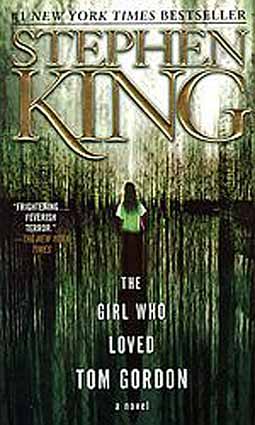
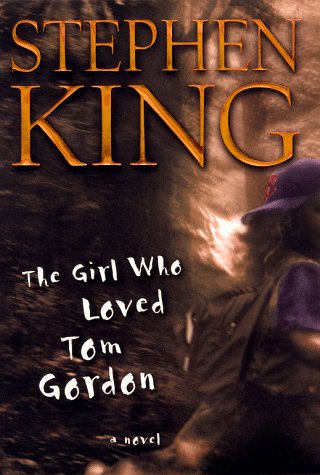
The Girl Who Loved Tom Gordon


My first Stephen King novel: The Girl Who Loved Tom Gordon. I found it appropriate because it's the first one of his I've ever owned; now I have a massive collection that I have yet to work on. My parents let me pick out any book I wanted when I was in middle school, and for some reason I picked this one. It must have been a best-seller at the time (1998), but it's been on my shelf ever since then. Now, I finally made the time to read it.

King's work is known for being really bizarre and horrifying. I've seen many of the film adaptations of his books: The Stand, It, The Green Mile, Pet Semetary, The Shining, Carrie, Dreamcatcher, Hearts in Atlantis. Eventually, I will read some of these books, but their plots are extremely intense, in-depth, and scary (for a lack of a better word).

The Girl Who Loved Tom Gordon was a bit different from the movies I have seen of his. The book is really about one person, a nine-year-old girl who gets lost in the woods. She wanders off of the path and finds herself lost in the woods in New England. She needs to rely on her basic skills in order to survive--she rations her food, she needs to eventually find food so she will not starve (fish, fiddleheads, nuts berries), she finds shelter, she follows a river because she knows it will lead to people. It's not too bad for a nine year old.

You may not think that the plot sounds too scary. However, I bet if you were tossed in the middle of the woods for nine days as a nine year old, you might think otherwise. King adds some other elements to the story to make it a bit more chilling: an unknown beast stalks her in the woods (the God of the Lost), and they eventually come head to end at the end of the novel. She also hallucinates at times, sometimes even seeing or hearing things because she eventually is starving and comes down with pnemonia.

Throughout Trisha's struggles, she keeps hope and fatih because of one person: Tom Gordon, closing pitcher for the Boston Red Sox. The only sanity that Trisha can find is from Gordon and the Red Sox. She listens to their baseball games on her walkman, also hearing small news announcements about her disappearance. The games give her a touch of humanity, and she feels not as alone. She convinces herself that if Gordon saves games, she will in turn be saved herself. Later on, she eventually starts to see Gordon in the woods. He communicates with her, sort of keeping her sane and pushing her to move on.

Not only does she hallucinate in seeing Tom Gordon, but she also hallucinates when she sees three dark hooded figures in a clearing near the river. They warn her of the God of the Lost and give her other forewarnings. Trisha constantly feels like she's beeing followed, and she basically is. What she thinks is the God of the Lost is really a bear. Once she finally makes it to the road, the bear comes charging at her. She hallucinates again, thinking it is the God of the Lost, and believes it wants to kill her. She decides to do exactly as Tom Gordon does when he closes games: he shows the opponent who is boss and stands his ground. So, in turn, Trisha stands her ground but is saved right before the bear attacks her. A nearby hunter scares away the bear, and Trisha is brought to a nearby hospital.

Trisha is eventually met by her parents (who are divorced) and points up to the sky just like Tom Gordon does after he wins games. Trisha's parents' divorce is a common thread throughout the novel. Trisha struggles with moving, dealing her with brother's hostility against the separation, her isolation, and her father's drinking. It is because her mother is so absent-minded over Trisha because of the divorce and external pressures that she is lost in the first place. However, the act of her going missing brings her family closer together, almost mending something that was broken.


Alcoholism seems to be a constant thread also in King's books. I think of The Shining for instance and wonder if King weaves in his own issues into his books--and why not? It was sad to see a nine-year-old girl affected by her father's drunkenness; no nine year old needs that kind of bad role model.

Even though the plot may sound kind of dry--just a girl traveling through the woods alone--King spruces it up with flashbacks and small adventures and problems that arise along the way. It was a pretty fast read, and it's a smaller book of his.

Some of the images that King portrayed were so clear that I could visualize, taste, smell, hear, or feel what he was describing. For instance, when he described the mosquitos lingering and buzzing and biting and swarming, it made me shudder as if I was there. His descriptions were so accurate and dead-on. Even for using this girl as his protagonist--I thought he did a pretty good job of characterizing her thoughts, especially from being so opposite of himself.

My only criticism of the book is in Trisha's language. She has very sophisticated thoughts and begins to swear all the time. Now, one could make the argument that she grew up a lot during those nine days and went through some pretty terrible experiences that would make her become more like an adult and vent her rage and frustration through swearing. Point taken. However, I just think it was a bit much and made me question the validity of the narrator.

I did like a lot of its underlying themes though. I enjoyed seeing what happens to the person who is taken away from society and needs to fend for himself. What happens to the person who is isolated in the woods? It's like the recent post I wrote on Deliverance--so many movies and books have themes (and dark ones) about true human nature, and that is truly discovered when one is away from society, in the woods or deserted on an island. This book also touches on that same idea.

Trisha must rely on herself to survive. She has crazy thoughts that run through her mind, and she relives moments of her life. This experience puts her life in perspective too; what was really important? What would I not take for granted when I come back? These questions and overall ideas are pretty interesting, for we are not naturally or normally confronted by them since most of us live pretty simple and straight-forward lives.

I also loved this novel because it touches on so many late 1990s cultural concepts: Surge, the Red Sox, walkmen, "Tubthumping" by Chumba Wumba. I was a little older than Trisha at this age, but it was awesome to come across these cultural references.

Wikipedia said that in 2005, there were motions to make this into a film. Does anyone know if that is being carried out? That would be crazy...

I was also shocked beyond belief to find out that it was made into a children's pop out book. Woa! And it's been translated into many different languages. I didn't realize its popularity!

Last note from Wikipedia on the symbolism and concepts behind the God of the Lost/the bear: "The novel also features many classic mythological and cultural themes. The entity that stalks Trisha referred to in the novel as 'The God of the lost' is very similar to the wendigo a predatory demon from Native American mythology that was said to inhabit the forests of the northeastern United States and Canada, and was said to torment humans lost in the woods before eventually devouring them. Another theme common to Native American cultures as well as cultures around the world is the concept of the ordeal, a rite of passage in which a candidate must prove him or her self by braving a dangerous or daunting task or undertaking to be considered an adult." Ponder those ideas...

For my first King book, I enjoyed it. I can see his talent and his critical acclaim. He is definitely one of the best authors alive at this time, and he will be forever remembered for his crazy mind and depictions of the world around him. The way that he can churn out books makes me envious--what a talent he has. My god.

So, what do you think about The Girl Who Loved Tom Gordon?

Monday, June 22, 2009

Helen Keller's The Story of My Life


I picked up Helen Keller's autobiography recently, The Story of My Life, because I was so unaware and curious about her life as a blind and deaf individual. Obviously I knew the bigger details surrounding her life, but I was still curious to understand how this individual live.

Now, I'm not trying to sound like a skeptic in this blog post, but I am trying to come to terms with her understanding of the world. Since Keller wrote this autobiography, she had a means to communicate words onto paper. She mentioned using a typewriter, which would make sense. In terms of her understanding and communicating with other people, did they have to sign words into her hands all the time since she couldn't see sign language and since braille was only available for published works?

I'm also curious about this fact as well: How could Keller understand such complex concepts if she could not see them or hear about them? Some concepts and vocabulary are very complex and take a great deal of teaching in order for someone to hear them. Keller had a very sophisticated vocabulary and understood very rich and deep concepts that would be hard for someone to understand, even if they didn't have severe handicaps. I'm just baffled at the thought!

I mean, Keller explains in The Story of My Life how she came to understand the concept of love. It took her teacher many, many tries with many explanations to have her understand love. She had to make her feel it from the sun as well as spelling words into her hands to make her know. I just don't see how a person who can't see or hear can even make sentences together because they are not exposed to language as much as someone else. I know she eventually grows to read braille, and not only does she read, but she reads in like three languages! This also blows my mind. I can't get over some of these facts!


I couldn't imagine living in the dark world Helen did, but I feel like if I had the same handicaps, I don't know if it would have been easy to understand the world as much as she appears to. It blows my mind. But, is she supposed to blow our minds? Isn't she supposed to be the symbol and the figure that stands for beating all the odds and going against expectations?

I was a bit cynical at first and still have some doubts. She really makes me question when it comes to the abilities and inabilities of humans. A friend of mine was talking about learning, and he was saying that just because Keller couldn't see or hear doesn't mean that she couldn't use her other senses to make up for what we have. Using those other senses, she could then learn what we can. You don't need every function to learn something, but I just wonder how deep her understanding is of those concepts when she does not have every function of every sense.

Maybe since I'm a visual learner, it's hard for me to conceptualize a person who does not have that function and can still process information fine. I just think that having BOTH handicaps puts her at a great disadvantage. I wonder how and what she was able to know based on both of these weak areas.

I hope I'm not sounding too mean; I'm just trying to come to terms with understanding her life and her abilities. Her autobiography was filled with sophisticated language and lists of books and studies she's completed. I find it honorable that she can complete so much and have such a thirst for knowledge when she had so many things against her. Some of my students who have no handicaps whatsoever do not have the drive that she did, nor do they have the focus to accomplish a lot of what she did. When under those kind of circumstances, there must be more of a reason to prove onself. Nowadays, not many really strive for it (or at least that's what I'm seeing in public schools). I hope to reverse that some day!

I really do believe that every person on this earth is put there for a reason, and many of us face challenges that would be too difficult for others. Stronger people are given harder challenges, or they have the potential to be strong and they rise to the challenge. I could see Keller as one of these individuals, and I honor the fact that she lived a life that many of us shun to think about (who would want this for a life?) but she seemed to make the best of it despite the odds. It's quite an admirable quality.

Anyway, Keller's book made me think about some really intense ideas about human's abilities with certain handicaps. Maybe someone knows more to shed light on what's missing from my interpretation.

So what do you think of The Story of My Life by Helen Keller?

Saturday, June 20, 2009

Parks and Recreation


When I initially heard that Amy Poehler was getting her own TV show, I was psyched. When I heard it was modeled after The Office, I was even more psyched. When I saw Parks and Recreation, I really wasn't as psyched as I started.

Amy Poehler is hilarious, but I think she's in a tough spot to make this television show work. I don't think it will last too many more seasons. To be quite honest, I'm surprised this show is lasting and Kath and Kim is not. Now, Kath and Kim wasn't the biggest gem, but Parks and Recreation isn't that much better.

Parks and Recreation is about Amy Poehler's character who works for local government in Pawnee. She is actively trying to build her reputation, so she takes on a project when a local complains about a giant pit that her boyfriend fell into. Poehler decides to fill in the pit and build a park on top of it. Little does she know how hard this task will be.

What is good about this plot is that it has a destination: to build a park on top of a pit. She has many roadblocks and hurdles to get past, but that is what the show is about. However, the dry humor and the characters, I don't think, are strong enough to hook viewers. While The Office has the same kind of plot where the season doesn't really go anywhere, it relies on its cast. However, the character and cast of The Office are hilarious while these new characters on Parks and Recreation are mediocre at best.

The Middle Eastern guy is not funny at all--I find him quite annoying. The boss is a little off, but he's okay. The teenage girl does a great job of portraying teenagers, but it still isn't hilarious. Poehler's love interest is an alright character, but he's still kind of skeevy. The only two I find connection to are their two stars--Poehler and Jim's ex-girlfriend from The Office. Without them, I would have no hook to the show. There is only so much that Amy Poehler can do.

I don't even really know what else to say about the show. I've seen all the episodes this season out of loyalty to Poehler, but I can't see why anyone else would tune in. I'm curious about how long it will last and how many more people will tune in.

I mean, don't get me wrong, some things are funny, but I don't think there's enough that works. The chemistry isn't strong enough, but maybe it will grow. I hope so anyway. I want Poehler to succeed.

So what do you think of Parks and Recreation?

Friday, June 19, 2009

Up


I was not expecting Up to be such a down-er (not to be too corny or anything). Last night, I was drawn to see Pixar's new film, Up, which is aimed at children as their primary audience for the film. I was shocked to see the movie with such solemn and serious tones imbedded throughout the movie! The previews did not portray the mature content that was persistent throughout the film.

What the previews showed of Up was an older man whose house is somehow lifted from the ground with hundreds of balloons. This older man finds a young boy scout on his porch (acting as an antagonist), and the two travel in this house with balloons to crazy places.

What was not introduced (and couldn't really be introduced in a thirty-second preview) was the purpose of this voyage of the old man. I'm about to spoil, so if you want to be completely surprised, don't read ahead. Mr. Fredricksen, the old man, is first depicted as a very young boy. He heard an adventurer speak at a local lecture hall, and from that day on, he wants to adventure. He meets a young girl named Ellie who also wants to be an adventurer. Through a series of actions (where the characters do not speak and piano overlays the shots), the movie progresses through their lives as they fall in love and get married. Then, the couple experiences Ellie not being able to produce children. Then they become older, but throughout it is shown how happy the two are together even though they remain living in the town that they vowed to live.

The couple's aim is to travel to a country in South America and live in Paradise Falls. They keep a jar to save up money to live there, but they continue to tap into the money as they need expenses to live (fixing popped tires, replacing the roof, etc). Eventually, they become senior citizens, and they are still in love. Then, and here comes the sad part, Mr. Fredricksen realizes that they never fulfilled their dream to go to South America. He buys tickets for them and plans to give them to her on a romantic picnic. As Ellie walks up the hill to the picnic, she collapses. The next shot shows her in the hospital, very weak but very loving. They gaze into each other's eyes. The next shot shows Mr. Fredricksen sitting alone on the alter of a church at her funeral. The piano music slows to a deafening stop, in which people begin to cry uncontrollably.


They showed the couple so happy and their dream so unfulfilled that it's ultimately extremely depressing. Okay, so this part is fine (even though very mature for young children) but it sets up Mr. Fredricksen's motivation to travel to South America and fulfill their destiny. However, these threads of his loneliness, isolation, and longing for his wife are continuously retouched throughout the movie, causing more and more tears.

Ellie had an adventure book, and on one page she wrote "Stuff I want to do" and she was supposed to write down everything they would do on their adventure (that never happened). But after Mr. Fredricksen arrives at South America without her, he opens up the book to find that she DID put pictures and memories after that part. Instead of having the adventure they had spoken of (traveling to South America), she had different adventures with her husband--growing old together. She put in images of them together and happy, which shows her happy life with him. It was HEART WRENCHING. Tears came again.

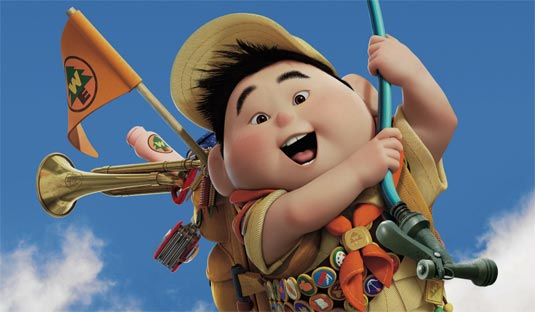
And as if that part wasn't mature and sad enough, they also drew upon some sad material with Russell, the boy scout who accompanies Mr. Fredricksen on his journey. He talks about his absent father who ran away with another woman. His father does not spend time with him anymore, and he misses his presence. He wishes that he could be at his boy scout meetings to award him badges as he is the only person who does not have a father to award them. There is a long awkward pause after this, in which some people again start to cry.

However, I do like the overall message with each story: Life is always an adventure, not always one that you planned, but even if that adventure goes sour or unfulfilled, more lie in the future of your life. Good can come from the bad. It is never too late to dream. It is never too late to fulfill the promises, hopes, and dreams that you set for yourself long ago, even if it seems difficult. It's a good message for children, but it was very racy and intense for them, in my opinion. I would have felt very shocked to see this with my children if I did not know the content beforehand.

Even though I might sound negative, I do think the movie was very smart and very good. There were many hilarious parts, as the comedy from the movie came from its abrupt nature. What I mean is this: the movie had many parts when something would happen so fast that it was hilarious because it would cut right to the next shot. There were many funny parts. There was enough comic relief to ward off the sad parts, but the movie seemed to operate like a heart monitor--high point, low point, high point, low point, and so on. It was an emotional rollercoaster, as far as I'm concerned.

I never saw where the movie was headed, with the introduction of "Kevin" the female bird, which was hilarious. Mr. Fredricksen eventually meets up with the explorer who made him want to adventure, except he is the bad guy. He wants to capture Kevin for his own pleasures, and Mr. Fredricksen and Russell decide to save this bird. Along with the help of a talking dog named Doug (dogs talk with collars created by the prestigious explorer). The talking dogs were hilarious; they really captured what dogs might sound like if they could talk. "Squirrel!" Hilarious.

Up had a colorful message like the colors strewn across its balloons, but it was also deeply tangled with some serious material. I think it can be read on many different levels, which makes a movie very good, in my opinion. I like its overall message, and I think it's one of Pixar's best so far. I hope I don't sound harsh because I did like it; I was just overly shocked and taken aback by the content, especially since it's a children's film. But, it was a pleasant surprise and I'm glad I got to see it.

So what do you think of Up?

Thursday, June 18, 2009

Treatment


I found yet another poem in The New Yorker that I would like to share. This one is called "Treatment" and is obviously on the same topic. I like the way the poet explores treatment and how someone going through treatment might see it. The poet uses very clever word play and images to make one see and feel as if one is going through treatment.

Let's see what you think. Enjoy.

Treatment

by Ange Mlinko

It's a little spa for the mind--seeing butterflies
set themselves down by the dozen like easels

on bromeliads, when out of the street the boutiques
are dilapidated, construction can't be told from ruin.

A single taste bud magnified resembles an orchid
but what that one's drinking from is a woman's eye

which must be brineless. I wonder what she consumes
that her tears taste like fructose. For minutes she's all its.

Then the moon rises and the river flows backward.
Composed of millions of tiny north poles, iron's

punched out of the environment, hammered into railways.
Pubs serve shephard's pies with marcelled mashed-potato crusts

and each tree casts its shade in the form of its summary leaf.
Is a woman's eye a single taste bud magnified?

Yet construction can't be told from ruin.
Out on the street the boutiques are dilapidated

by the dozen like easels. And the mind--it's a little spa.


I really like the use of repetition throughout the poem. It emphasizes treatment and how the mind needs to continue to learn and go back through previous events to come to certain conclusions. When in treatment, one must also continue to focus on a certain mantra or overall theme on which to focus. I also like how it was not worded exactly the same because our lives do repeat themselves, but they do in slightly different fashions each time.

My favorite line: "Yet construction can't be told from ruin." I love seeing treatment as construction--you're rebuilding the soul and healing parts that need repair. And, from ruin you can really go up. But, you can't talk about construction from ruin; it's only when the "house" is complete that one can look back and reflect and see how treatment really was, or how ineffective it was. I like looking at the soul or a person as a house that can go under construction and can also fall to ruin. It's a creative image.

Also, I see the easel almost like that surface on which we can keep creating and changing ourselves. It's not the palet, it's not the clean slate, it's the easel. It holds up how we can keep shifting ourselves, becoming weaker and stronger, which I find quite an interesting idea. Life is a constant shifting of ourselves, and it's how we paint that portrait of ourselves that is really quite fascinating.

Now, I'm sure some of the other random images in there have some sort of purpose, but I also wondered if they were randomly placed as to allude to the "crazy" person in treatment. This person may say things that seem really "crazy" but in effect are really meaningful. I'm sure they all make sense somehow, but I can't piece them all together.

Thinking about it, I'm sure the butterfly image is in there to suggest the transformation of the soul in treatment. Once a caterpillar, the soul can transform to a new soul, one who is healthier and stronger, much like a butterfly. That new soul is then more colorful and can fly, and you could never tell that the two things were once the same.

Drinking from a woman's eye?? To take in all that woman is seeing? To take another's experience and learn from it? Maybe to see the harm you might have caused on others to see how you can grow yourself from that? Maybe to see your effect on others to help your own treatment and to help out those you have previously hurt? What does that line mean then? Am I way off?

I also like the image of the tree and the leaves. Treatment can also be like a tree which constantly changes but always grows. It continues to shed its leaves and become new every season. Sometimes the tree looks ugly and sometimes it looks beautiful, just like humans go through stages like this too. But, it's all inevitable. We just need to embrace those dark winters we humans face to get over it (perhaps through treatment) and to come into the light to be positive and strong.

And what's up with shephard's pies? My brother loves them to death, but what do they have to do with treatment? I know they're a mish-mash of food, but what is the significance with treatment?

Lastly, I like the reference of treatment as a spa for the mind. It seems so obvious, but it's so clever. I wonder if this was the nugget the poet had in mind and then this poem budded from that thought. That's the initial feeling I got from the poem. Sometimes I have one line that permeates through my mind, and I want to capture it somehow. And sometimes all it takes to get a poem or a story or a blog going is to just start with that one line. Then the rest follows. It's very cool when such a beautiful phrase like that can repeat in your mind. I hope that's how it happened to the poet.

So, what do you think of "Treatment?"

Wednesday, June 17, 2009

Neuroenhancing Drugs


The New Yorker once again stunned me with an article that I was extraordinarily interested in. The article is called "Bran Gain" by Margaret Talbot and it's on this new culture of neuroenhancing drugs--drugs like Adderall and Ritalin that many college students are starting to take in order to stay up longer to produce papers and projects.

When I was a college student myself, I was introduced to this culture of taking Adderall. However, I never needed to take it and never did. Many of my friends took it, but these friends were people who had a very difficult time focusing, some of them who might even had undiagnosed learning disabilities. I'm not excusing their behavior by any means, but I am perhaps diagnosing why they had to resort to Adderall at the end of each semester.

Why would my friends (and other students) take Adderall? Many of my friends would procrastinate and save things until the last minute. One friend had a forty page paper due (which should have been done in increments throughout the semester), but she blew it off. Instead, she popped a few pills and stayed up for days typing the thing away. Other friends would cram for tests, but many would use it to write long term papers. They say that it worked pretty well.

But, there were some downsides to it. Some of my friends would get a little "sloppy" and "under the influence" and instead of cramming for a test or churning out a paper, they would end up going on rampages to do other things. One friend felt so obligated to clean his apartment, so instead of working, he cleaned every last inch of his apartment. Another friend was pretty drugged up and basically talked with another friend for hours (both who were on it). Another friend was TOO into it and was bugging out. She couldn't focus on the task because she was overthinking it. The drugs actually stalled her progress.

So, unfortunatly, Adderall can go both ways. It can really push students towards the finish line to finish long projects or papers or it could be detrimental and make the student even farther behind. Note of wisdom: Just don't procrastinate to have to take these pills...

Before college, I had never heard of these kinds of pills. Many students would sell them right around finals time. Many people would even ask if I had any that they could buy. I never wanted to get involved in this stuff. But, the thing is, this culture is becoming more and more popular. This world of neuroenhancing drugs is growing rapidly as we speak, and it's a little scary if so many students need to depend on these drugs instead of learning time management.

I mean, are you really learning something if you're cramming in dark hours as opposed to learning slowly over a period of time? No. It's just cheating the learning you could be doing. The brain slowly learns over time through repetition, exposure, and practice. One night will not do justice to any learning process. It's a travesty. Then we will churn out these college students who really don't know too much. What kind of a society are we producing?


I want to include some interesting notes and facts from the article on these neuroenhancing drugs, including Adderall and Ritalin. Enjoy:

-Both drugs are normally prescribed to children and adult who have ADHD--Attention Deficit Hyperactivity Disorder. It makes people become "high-functioning, overcommitted."

-"In 2005 [...] the University of Michigan's Substance Abuse Research Center reported that in the previous year 4.1% of American undergraduates had taken prescription stimulants for off-label use; at one school, the figure was 25%."

-"A 2002 study at a small college found that more than 35% of the students had used prescription stimulants nonmedically in the previous year."

-"Drugs such as Adderall can cause nervousness, headaches, sleeplessness, and decreased appetite, among other side effects."

-Adderall has high potential for drug abuse and can possibly lead to cardiac problems later on in life.

-"White male undergraduates at highly competitive schools--especially in the Northeast--are the most frequent collegiate users of neuroenhancers."

-"Users are also more likely to belong to a fraternity or sorority, and have a GPA of 3.0 or lower."

-In the scientific journal Nature, people polled were asked if their senses are sharper and if their focus, concentration, and memory are sharper on neuroenhancing drugs. 1 out of 5 respondents said that it did.

-"What's the next form of society? The neuro-society."

-"He didn't really like the term "enhancement:" We're not talking about superhuman intelligence. No one's saying we're going to come out with a pill that's going to make you smarter than Einstein! ... What we're talking about is enabling people."

Some people argue that taking these neuroenchancing drugs makes it an unequal education and those who take it have an unfair advantage and edge over those who don't. Some schools even want to test students for taking them to make sure that they are fairly completing final assignments.

Others believe that anything that helps intelligence is a good thing. If there are so called "smart pills," why shouldn't we be allowed to use them? There are both sides to the argument.

Some students, as depicted in the article, take them because they simply need to keep up with other students in a fast-paced environment like Harvard, and the only way they can do so is to take these drugs. Another individual depicted in the article was a poker player who focuses much better on the game when under the influence of this drug. Since then, he's made tons of money. The question is, is it fair?

And, are classes really getting harder? It seems that standards have actually been dumbed down in the past few years. Or, were these people who just couldn't keep up ones who dropped out? Was it like survival of the fittest? If we allow these people to get through, who are we really pushing by? Will they be successful and adequate for the degree they will have? Hm...

I also know that I might be offending people who often take Adderall as the culture is slowly growing. And maybe I have a difficult time understanding it since I never needed stimulants to help me focus. I was born with the uncanny ability to do so on command. Maybe I'm not seeing the whole picture, but I'm also trying to look at it from a health perspective and a cultural perspective. The key to my argument is fairness. I hate to see people who slack off and goof off and then pull everything off in the last minute. The real world doesn't work that way, and when that lesson DOES come, it will be quite shocking. Some people just try to push this off forever and ever, and it will eventually catch up to that person. We are eventually held accountable someday; I just think that students in college should be held accountable. I mean, they're basically adults at that point. When else will the reality check set in?

So what do you think about neuroenhancing drugs?

Tuesday, June 16, 2009

Let the Record Show


I found this poem in The New Yorker, and I really enjoyed it. Unlike other poems I find in that magazine, I immediately connected with this one. I think I even chuckled to myself after I read it the first time.

This poem is exactly how I like poems: it's quick and simple. It's pretty much to the point, and the message is pretty clear. I found it rather amusing because I'm sure we've all had days like this. Enjoy.

Let the Record Show

by Dora Malech

I spent the morning trying to remember
the joke about a peanut and assault.
People dropped bombs on each other elsewhere.
I knew that many of them were at fault

and many blameless. I kept my office locked
and the lights off. The phone just kept ringing.
I didn't answer. Nor when someone knocked.
I was supposed to be doing something.


I'm sure we've all had these moments. Or days. Or months. Some days the brain just isn't as "on" or "focused," even for the smallest details that we can't piece together in our minds.

I like this setting that is painted for us: the person locked away in the office pretending to be busy but really pondering something that doesn't really matter. We all have lives like this. I also like how the poet describes how greater matters are going on--wars--yet here we sit in our quiet solitude contemplating such trivial affairs. I loved the connection and the paralellism.

I just think of college when work is supposed to be done, we're supposed to be doing something, but we're really not. In this case, the adult is pretending to be involved yet refuses to take phone calls or be bothered. When not responding, others assume that the person is too busy to take the response, but sometimes, we really aren't at all. Sometimes people just need a personal moment; other times, we just need to reflect on something in life (be it a joke that we can't remember). Sometimes we just need quiet (believe it or not) even if it falls within work hours. That's what I enjoyed "Let the Record Show."

What do you think of the poem?