Sunday, June 7, 2009

Shepard Fairey


MAKE ART NOT WAR

OBEY

Rolling Stone recently featured a small article on Shepard Fairey, a contemporary artist and graphic designer that has been receiving some fame as of late. His stuff is absolutely incredible.

Fairey is most known for his artwork from Obama's presidential election. The famous red, white, and blue picture of Obama with the word "HOPE" under it is his most famous piece, a piece that we all recognize but might not understand that this is the work of this man, Fairey.

You don't really read or hear about many famous artists, let alone graphic artists. Maybe I don't seek out great new artists, but I don't hear much about great artwork and great artists these days. I think it's such a respected profession that not many attempt since it doesn't pull in too much money. This is the kind of creativity we need here. I love to see it happen.

He has since ventured into some more political works dealing with the war we are in, so he is becoming a bit more contorversial than his popular Obama poster. But, he does seem to stem his work in politics. He is VERY effective in his message just by using images or maybe one word or two.

I wanted to take the time to showcase some of his artwork. It is very simplistic and unique. It almost has the feel of 1960s psychadelic rock posters. His work is so signature that you would be able to tell that it is his just by the way it looks. THAT is the sign of a great artist.

Shepard Fairey's work:


So what do you think of Shepard Fairey and his work?

Friday, June 5, 2009

The Long-Term Marriage


I have another great poem I found in The New Yorker yet again. The title of the poem is pretty self-explanatory towards the subject of the poem, and that subject, I find, is very interesting. Check it out.

The Long-Term Marriage

by Spencer Reece

At last she's happy, reigning with her creams,
rubbing his scalp's roof until it gleams.
As the squamous-cell carcinomas sprout,
the local dermatologist cuts them out

or frosts the lunar surface with liquid nitrogen.
The creams come from West Fourteenth Street, Manhattan,
FedExed from their adopted son's boyfriend's home,
a relationship that remains, to them, unknown.

Their Oriental rugs are steeped in piss
from the bulldog barking like an activist.
Bickering over misplaced books, the tchotchkes
lost, and how she re-remembers her stories,

they wait with an unfinished, finished look,
and note how honeysuckle crowns Old Saybrook
and thistles overrun their last garden.
The dash between their dates is nearly done.


So many details in this poem screams "long-term marriage," the marriage that has been going on for a very long time and that, perhaps, has fallen into patterns and has lost some of the initial flame and luster.

This couple seems to be very well off, having Oriental rugs, having creams ordered from a street in Manhattan, focusing on creams, having so many tchotchkes, the garden. What's the point of having the elite married couple? Are they just for show with their money? I always pictured (if I was going to write a poem with this same title) a couple that is middle class. Maybe that's because I'm from middle class and that's what I would picture, but I guess I also picture elite couples not to be married for long-term either. Or maybe my perception is just different from others.

Marriage details: Having a dog. Having that dog pee unexpectedly and dealing with it. Having an adopted son. Not knowing about the adopted son's homosexuality. (I wonder what they would say or whe the son remains in the closet. I wonder if they have suspicions or, if they are like most parents of homosexuals, in denial.) They collect tchotckes, way too many. They have a garden. They have conversations about gardens.

The days blend together.

Time passes quickly. I guess that does happen with couples. That must be weird when the days go by fast, but then when the years go by fast. That must be scary when they become decades. Oh wow, there went the 80s... there went the 90s... That must be scary.

That's my meditation over the poem. What do you think?

What do you think about "The Long-Term Marriage?"

Thursday, June 4, 2009

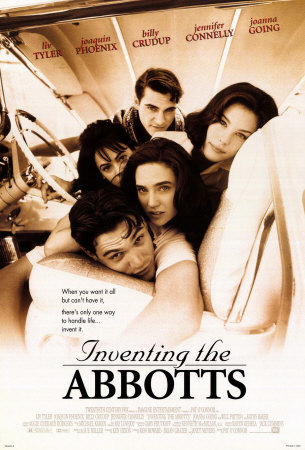
Inventing the Abbotts


Inventing the Abbotts, a 1997 drama flick, was on television the other day, and I couldn't help but watch it. The title sounds like it's memorable and notable--culturally significant--and I guess I'm trying to figure out why. Not that it was terrible, but I'm trying to find its importance and significance.

Iventing the Abbotts was based on a short story by Sue Miller--has anyone read it to compare to the film?--about teenagers in the 1950s. For those wanting to depict teenage life in the 1950s, this one is pretty good. Fancy parties, dancing, sex, drinking, trying to maintain the clean image but trying to be "bad," etc. It is a bit over-the-top for a classroom, but parts of it would be clean enough to show.

The movie is about this prestigious, upscale, rich family in this small town: the Abbotts. The father owns a company and has tons of money to throw away at parties (many of the central scenes in the movie). He has a few daughters who are all different in their own way, but they are all remarkably beautiful (two are played by Jennifer Connelly and Liv Tyler). Connelly's character is more daring and dangerous while Tyler is more reserved.

The focus remains on two boys, Jacey and Doug, who are brothers. Jacey is older and is more hotheaded; Doug is younger and more cautious, but he wants to be like his brother. Their father died a while ago, when Doug was born, so they are raised by a single mother. A rumor exists that their mother gave up the company to Mr. Abbott after an affair. Jacey resents his mother and the Abbotts, seeking revenge on them all. Thus, he tries to (and eventually does) court each girl, sleeping with them, to try to sleep his way into the family. Each time, Mr. Abbott breaks up the relationship, sending the daughter away somehow.

However, Doug is in love with the youngest daughter played by Liv Tyler. They have a playful, loving relationship, but Tyler's character ends their relationship during high school because of the turmoil caused by Jacey's actions. She doesn't want to be associated with that name and family.

Doug then goes to college, following his brother to Pennsylvania, where he studies theatre design. He eventually runs into Tyler's character, Pam, and he tries to pursue her but Pam is resistant. We find out she is resistant because she has been sleeping with Jacey. Doug is devistated, punching his brother, ignoring him, and keeping in private. He eventually comes to terms with it once his mother passes away, a reason for them both to come back together. Doug ends up finding Pam again, and the movie ends with them getting back together.

An earlier line in the film stated that Jacey had "invented the Abbotts," and if they didn't exist, he would have invented them anyway. Now, I'm trying to think of the significance of these lines and the title.

To Jacey, the Abbotts were something that he devoted his life to either destroying or becoming a part of it. He would destroy it if they shunned him, but he was FOCUSED on their family, obsessed. Maybe he needed something to taget and focus on because there was nothing else. He needed someone to blame for his father's death and some way to punish someone.

Not to mention, Mr. Abbott also sold his father the car that he drove over the ice to his death. Mr. Abbott also dared his father to go across the frozen lake for ten dollars. Jacey placed a lot of blame on him even though we find out in the end that Jacey's father fairly sold the company to Mr. Abbott for the car (as a trade), and that there never was any affair. Mr. Abbott was only consoling Jacey's mother after the death of their father.

So, what is inventing the Abbotts? Were they really not the luster they were cracked up to be? Did Jacey "invent" who he thought they were? Do people need some higher authority to fantasize about or blame?

The movie was pretty interesting because it included popular actors when they were young: Jennifer Connelly, Joaquin Phoenix, Liv Tyler, Billy Crudup. It was a bit dramatic, but it is worth watching.

So, what does the title mean and what do you think of the movie?

Wednesday, June 3, 2009

The Poem That Can't Be Written


I really liked this poem I found in The New Yorker a few months ago. For those who love poetry and love to write poetry, this poem may speak to you. It makes sense that a poet would write about the difficulty or writing poetry--therapeutic. And, he/she's speaking to an audience who will listen. It's quite a good poem. Check it out.

The Poem That Can't Be Written

by Lawrence Raab

is different from the poem
that is not written, or the many

that are never finished--those boats
lost in the fog, adrift

in the windless latitudes,
the charts useless, the water gone.

In the poem that cannot
be written there is no danger,

no ponderous cargo of meaning,
no meaning at all. And this

is its splendor, this is how
it becomes an emblem,

not a failure or a loss,
but of the impossible.

So the wind rises. The tattered sails
billow, and the air grows sweeter.

A green island appears.
Everyone is saved.


The poem that can't be written. I'm sure many people could argue about what that kind of "poem" is. Maybe I don't even have the right understanding (and maybe someone could point it out), but I kind of see it as some reflection on the human experience that can't be put into word form. There simply is no way to communicate certain experiences or thoughts. This is the poem that can't be written.

What do you think the poem that can't be written is?

I love the images that the poet gives to describe such a poem. The boat lost in the fog, the boat that is exploring the vast ocean yet wants to return to the homeland. Tattered sails, unexplored cargo, the ship lost at sea. It's such a brilliant concept. They explore the sea for a personal meaning (perhaps discovery) and face adversities. They then want to return and are saved. No problems, no losses--only positive things.

Even the style of the poem contributes to the meaning. I love the way it starts off in mid-sentence. The sentences slowly grow shorter. It's very intelligent.

So, what do you think of "The Poem That Can't Be Written?"

Tuesday, June 2, 2009

Deliverance


Deliverance: Rescue; recovery or preservation from loss or danger; "work is the deliverance of mankind."

For the first time in my life, I saw Deliverance, the popular 1972 action/drama cult-classic film starring Burt Reynolds and John Voight (a young John Voight might I add). I watched it because of its popularity and recognition among popular American culture, and I was shocked to see the movie and then recognize how many people like this movie after seeing what it is all about.

Basically, Deliverance is a book that was turned into a film. It takes place in rural Georgia and basically tracks a weekend of four friends who go on a canoe trip. They drive to the top of a mountain and plan to canoe and camp all the way down. For some reason, as they make their way down the mountain, they come across mountain folk who give them a hard time (and by hard time I mean raping and hurting). Two of the friends save the other two friends, except one man kills one of the mountain men. The other gets away. The men then fight about what to do with the dead body.

The men decide to bury the body because the river is soon going to be dammed, so no one will ever find it. As they make their way down the river though, one man goes crazy and falls overboard, causing one canoe to break and the other to tip. The four men fall down the river and down a waterfall where one is killed and the other is severely injured with his bone sticking out of his leg--gross. The two remaining men then have to hunt down and kill the other man, dispose of their friend's body, and make their way to the mainland to cover everything up.

Now, this movie/book is so similar to themes and ideas of other books: when man is immersed in nature, how does he behave? What is man really like when laws and structure are taken away? What is man's true nature?

This theme is prevalent in many major works: Lord of the Flies, Lost, The Blair Witch Project, The Road, Without a Paddle, Touching Spirit Bear, The Stand, etc. In all cases, the law is stripped from these characters, and some people become power-hungry and others disobey the law. How will man truly act when he has no consequences from which to stop him from doing whatever he wants?

I did like connecting this major theme from the movie to others and assessing what the major ideas were, but I have to admit, these movie was pretty disturbing. I enjoyed it, but it stuck with me for a few days. I couldn't (and can't) get the rape scene out of my head. It was SO disturbing to me. I can't let it go because it is just so disgusting and horrible. I've seen other rape scenes in movies before, but for some reason, this one is lasting with me more than the others. It really bothered me. I know it's a pivotal scene in the movie because it causes the death and the fighting back, but it was just so powerful. Man, I'm just speechless with how traumatizing it was to me.


I also liked how short and real that it was. It was one big event that was played over a small amount of time. It was really clever. And what I also think is interesting is that the people in the beginning are real natives of the Georgia area. They were not actors; they were real country folk who acted in the movie. (And can I just mention how creepy that little boy with the slitty eyes was who was playing the "Dueling Banjos?" Yikes...) That really added some flavor to the movie.

Actors fit in very well with their roles too. I like how Voight's character was pretty weak. They show his gradual development into a hardened man who is able to kill from his softer character in the beginning. Very well done. Reynolds' character was a bit dramatic. He was overacting at times, often staring into the distance and reciting his lines, which I thought was a bit cheesy for a burly man that he was playing. It reminded me that he was acting while the other actors looked natural.

And, how much training did these guys have to do to be able to canoe down rapids like that? That must have taken a few weeks/months of training...

I want to add some facts I found that I think are pretty interesting about the film:

-In 2008, Deliverance was added to the United States Film Registry by the Library of Congress as being "historically, culturally, and aesthetically significant."

-The rape scene is noted in a song by The Revolting Cocks called "Beers, Steers, and Queers (The Remixes)" in 1991.

-The rape scene is also noted in a South Park episode called "The China Probrem" in 2008.

-"Squeal piggy" did not appear in the book. It was improvised for the film.

-The film was the basis for Without a Paddle. Burt Reynolds made a guest appearance in the film as an homage.

-In Primus's song "My Name Is Mud," they recite the famous line spoken by the hilbilly, "Where you goin' city boy?"

-The writer, James Dickey, appears as the sheriff in the film.

-The film won 3 Golden Globes (Best Picture, Directing, and Film Editing), 5 Golden Globe Awards (Best Motion Picture, Director, Actor, Original Song, and Screenplay) and New York Film Critics Circle (Best Film and Director).

Can anyone explain to me why this is a cult classic?

So what do you think of Deliverance?

Monday, June 1, 2009

Matthew and Michael Dickman


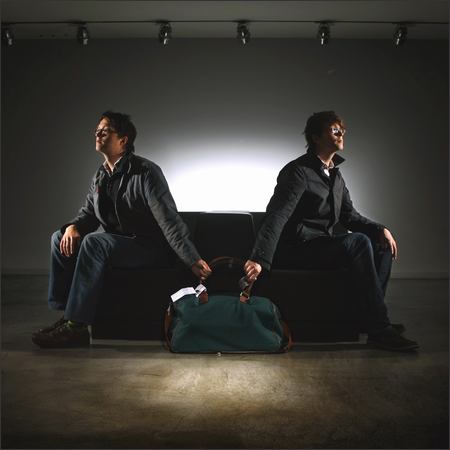
The Dickman twins completely astonished me when I discovered them: the two men are twin poets. Yes, twin poets. What a crazy situation.

The New Yorker featured them in a breathtaking article called "Couplet" by Rebecca Mead. The two poets are basically identical, looking only slightly different than the other. They both live in Portland, Oregon where they grew up, but being a poet is hard. They both have regular jobs and write poetry for fun. (Michael works as a prep cook and Matthew works at Whole Foods). The thing is though, these guys are ridiculously talented. It blows my mind that these two are still working menial jobs when they have so much literary talent! Matthew just recently won an American Academy of Arts and Sciences prize for poetry in 2008. These guys are brilliant!

You might even notice these two guys as the twins in Minority Report. They were the two twins in that massive pool of water that were hooked up to all of those tubes. They said it was the perfect environment for writing poetry--lots of thinking time.

Even though they are twin poets, they both write about very different topics. They do edit each other's pieces, as they understand the meanings and directions that they are going with their work. Again, this blows my mind, and I am borderline jealous. I wish I was a twin, AND a poet! Could you imagine being both?

They both draw on similar themes: "the rough neighborhood of their youth, with its violent fathers, beleaguered mothers, and reckless, neglected kids" ("Couplet"). But, they are seen as two different poets altogether. Although they share the same experiences, they offer two completely different perspectives on the same topic or event.


Michael Dickman: His poems are fragmented, interior, and austere. They are stripped down to single word lines. They are often about violence or are described as "dead". Reading his poetry is noted as "stepping out of an overheated apartment building to be met, unexpectedly, by an exhilaratingly chill gust of wind."


Matthew Dickman: His poems are effusive, ecstatic, and all-embracing. They are filled with pop-culture or sexual references. Reading his poetry is noted as "taking a deep, warm bath with a glass of wine balanced in the soap dish."

The twins' love for poetry grew in high school when Matthew's girlfriend was reading Pablo Neruda poems. They fell in love with poetry and have been ever since.

This story was fascinating to me: The Dickmans met Allen Ginsberg. They met him at a book signing when Ginsberg asked Matthew, "How's your love life?" Matthew scurried away but later came up to him, apologized, and asked him the same question in return. Matthew explained the situation of him and his brother as poets, and they went to tea afterwards. The next night, Ginsberg invited Matthew to dinner. They went up to his hotel room afterwards, talking about poetry and smoking cigarettes, and they exchanged information and poetry. (Can you imagine getting originals of Ginsberg poetry?) Then they kissed for fifteen minutes. Again, another crazy experience.

Also, they were approached by a publisher in New York to both write poems on their birth. They both wrote very different poems. It would be amazing if they wrote poems on similar topics and had them appear right next to each other. That poetry book would be legendary.

Here are some of their poems:

"Lents District"

by Matthew Dickman

Dear Lents, dear 82nd avenue, dear 92nd and Foster,
I am your strange son.
You saved me when I needed saving,
your arms wrapped around
my bassinet like patrol cars wrapped around
the school yard
the night Jason went crazy--
waving his father's gun above his head,
bathed in red and blue flashing lights,
all-American, broken in half and beautiful.


"Some of the Men"

by Michael Dickman

Look at
Josh's father--

Stumbling into the bedroom at three
in the morning the two of us asleep
and all that moonlight
and beat his son's
head against

the headboard


You fucker you fucker you asked for it


The moon

His jaw splashed across the pillowcase.


"Slow Dance"

by Matthew Dickman

Two men in the middle of the room.
When I dance with him,
one of my great loves, he is absolutely human,
and when he turns to dip me
or I step on his foot because we are both leading,
I know that one of us will die first and the other will suffer.


"Nervous System" (excerpt)

by Michael Dickman

When you look down
inside yourself
what is there?

You are a walking bag of surgical instruments
shining from the inside out

and that's just
today

Tomorrow it could be different

When I think of the childhood inside me I think of sunlight dying on
a windowsill

The voices of my friends
in the sunlight

All of us running around
outside our
deaths


So what do you think of the Dickman twins?

Friday, May 29, 2009

Feed


Here I go again with deliving into science fiction... I just finished reading Feed, a dystopian novel by MT Anderson. The cover of it drew me to it; it also looked pretty new and innovative, so I thought I would give it a try. I was awfully surprised!

Feed takes place some time in the future where humans are able to travel to different planets just as a vacation. People also live above the Earth (sort of like in Star Wars), and they drive up cars (above Earth) and down cars (those down on Earth). The world is overrun by consumerism by this thing called the feed.

What is the feed? Basically, 60% of the population has this device called feed installed into their brains. The feed is basically a computer that becomes a part of your brain. It gives you pop up ads when you're shopping or stressing interest in purchasing something; it allows you to telepathically speak with one other person, similar to AIM chatting; it allows you to save all memories, and you can even send them to people if you want; it allows you to watch television programs. Basically, the feed provides the same functions of a computer, but it's attached to your brain. The only problem is that it can be hacked into by external parties--even the government.

Since this takes place in the future, Anderson imbeds a lot of commentary on his vision for the future. For example, he has America overrun by consumerism with the feed. He has the United States in a state of panic and chaos. Nations of the world are constantly at arms with one another, even threatening possible total anniahlation. The environment has gone to hell; animals and plantlife are basically at their ends, or are a thing of the past. Humans are shallow and stupid; they rely on their computers for their intelligence, and, without them, they would really just be shells.

Feed contains two main characters: Titus, the narrator who enjoys having the feed, and Violet, the girlfriend who does not like the feed. Hearing their discussions on having or not having the feed is very interesting. Violet represents the "older world" that does not like computers, consumerism, and technology overstepping its boundaries. Titus represents the new age of computers and technology making life easier (or even too easy to dumb down things). Violet tries to convince Titus to resist the feed, but he does not end up being able to do so. Violet's feed ends up destroying her (basically killing her) which is kind of ironic when you think of the symbolism.


Wikipedia offers a very cool explanation of the characters' symbolism:

"Though Titus is largely unaware of it, the America of the book is rapidly collapsing, a decline that mirrors that of Violet. In some ways, Violet represents what the author believes America should stand for. Just as Violet does not quite die in the book (the last chapter being called 4.6%), it is never explicitly stated that America ends, though the damage, like the damage to Violet, is likely completely unrepairable. The world may also end as a result of America's actions, with the severe damage to the health of the general population and enormous ecological disasters. Meanwhile, Titus, the consumer, and Anderson's image of what America is becoming ignores and distances himself from Violet to avoid hearing what she has to say. The book ends on a very pessimistic note."

I also did like how the novel didn't end so wonderfully. I think it sets the tone for how Anderson sees us heading. He also doesn't have the wonderful love story work out in the end, because it doesn't always. It's a tragic ending, and Titus really is a stubborn, arrogant teenager. I hated him towards the end, but that behavior is typical of male adolescents. It's so realistic and so frustrating all at the same time!

The book also includes this function called "in mal" where teenagers purposely have their feeds malfunction to stimulate pleasure and joy. It's basically the equivalent of doing drugs. But, I think it's interesting because drugs essentially shut down or malfunction in the brain, so it's cool to compare the two because people don't often always see it that way.

Overall, Feed was a great book. Boys could really get into this piece. It acts as a great means to discuss the future, technology, drugs, and consumerism. And, it's easy to read. They just kind of have difficult language (made up language to imitate changing dialects in the future), but you catch on after a while.

So, what do you think of Feed?

Tuesday, May 26, 2009

Cancelled Shows 2009

I was surprised to recently come across the list of cancelled shows or shows that are not returning for upcoming seasons. This must have been a tough years for shows to survive. Does the financial crisis have anything to do with these shows cancelling? Are funding and survival rates highly dependent on the economy?

Here is a list of shows that were either cancelled or are not returning for the upcoming season:

My Name Is Earl
Samantha Who?
Kath and Kim
Boston Legal
ER
King of the Hill
Without a Trace
Prison Break
Kings
In the Motherhood
Sit Down, Shut Up
Swingtown
The Unit
Eleventh Hour
According to Jim
America's Toughest Jobs
American Gladiators
Crusoe
Deal or No Deal
Dirty Sexy Money
Frank TV
Howie Do It
Knight Rider
Kyle XY
The L Word
Last Comic Standing
Life
Life on Mars
Lipstick Jungle
MADtv
Momma's Boys
My Own Worst Enemy
Osbournes: Reloaded
Pushing Daisies
The Shield
Terminator: The Sarah Connor Chronicles
The Tonight Show with Jay Leno
TRL
The Unusuals


Check out reasons as to why these shows are cancelled here or here.

And to be honest, I didn't even list ALL of them. These are the ones I think the general public would be familiar with. Some of these really trouble me (My Name Is Earl, King of the Hill, American Gladiators, MADtv, Last Comic Standing, Deal or No Deal). Maybe I'm living in a bubble or something, but I thought that a lot of these shows got some decent ratings. I thought they were fairly popular. Now, don't get me wrong, a lot of these shows were destined to fail. I was surpirsed some lasted as long as they did. Others were first year shows that got the cut early on (no surprise). I am just shocked at HOW MANY are cancelled.

Do this many shows normally get cancelled every season, or am I just seeing one season and going a little overboard here?

I guess I'm just trying to figure it out, and there are just so many! A lot of these were pretty good shows (or there names were just widely recognized). What other shows are they going to put on in their place? It seems like they have to create a lot of new ones to make up for these old ones. New shows are hard to pitch and sell to an audience. Let's see how the networks do...

So, what do you think of these cancellations?

Sunday, May 24, 2009

So, So It Begins Means It Begins


I saw this poem appear in The New Yorker a few months back. It caught my attention, but I was sort of confused by its meaning. After pondering it for a few more minutes, I want to explore what it might possibly mean. Any other means of interpretation would be very helpful.

So, So It Begins Means It Begins

by Mary Jo Bang

And so it begins, Mickey, birthday cake (party), special
Night, whoops, and take a box.
So it begins, take a bow, hold your head up,
Scowl now. That is your own guitar.

Stop and see a movie.
Stop and see whether the eagle holds up at the end.
I'm leaving. See how I pull the door to.
The door is the floor and it's rising up.

Below is a dungeon. It's all you can see in the dark.
There is graffiti on the wall.
The bugle has ceded its call to power.
It's the time when we are waiting to be told.

Nothing is getting better. And nothing is getting worse.
A duck and a mouse. A house and a hat.
Having lunch and having a medal of honor.
Let's put our culture on a cartoon's.

Why not? Have the mouse answer the phone.
Have the receiver click. Then the real comes to
Its awful end. That point where, as he said, all came in
"With the shoutmost shoviality. Agog" Agog.


So, so I think that it starts out at the beginning of life, when everything is simple and excitement comes from a simple birthday cake or Mickey Mouse. This "mouse" and "cartoon" thread seems to go throughout the poem.

The rest of the poem seems to show the dullness of growing up. Nothing is exciting anymore like it used to be. Our lives are even kind of like cartoon's--not too deep, not really changing, always there, pretty dull: "Let's put our culture on a cartoon's." Our culture is somehow mirrored through this cartoon, and we sort of live it ourselves too. It never leaves us even as we age.

There are smaller bits and phrases that I'm not really connecting with: bugles, medal of honor, movie, the door and its rising. I bet they connect somehow, but it's not coming to me. And what's with agog?

And what's with the title? So, so it begins means it begins. Life begins right from the start (in some kind of state or with some kind of impression or mood) at an early age? We start out as children with this idea she's trying to get across and it stays with us through adulthood? I don't know if I'm really connecting with this.

What do you think of the poem? Any suggestions or meanings?

Friday, May 22, 2009

What Is the What


Being a Dave Eggers fan, I was found myself interested in picking up another one of his books. I was quite reluctant to pick up his newest book What Is the What. I'm not very knowledgeable or very interested in Africa, so this book was not very appealing to me. However, I did come to like it because it taught me a lot about the Sudan that I really had no concept of before.

What Is the What is really titled What Is the What: The Autobiography of Valentino Achak Deng, a novel. The prologue to the book explains that Eggers met up with the real life Deng and wanted to tell his story. He didn't know how to actually portray it though, so he interviewed Deng exstensively on his life story. In order to avoid much criticism and to be allowed more freedom with the story, he decided to make it a novel so he could add dialogue and perhaps dramatize certain characters and relationships. However, most of the novel is true and based on real situations that Deng experienced.

What Is the What is about Deng's life in Sudan during their civil war. Deng wakes up one morning as a young boy when his village is being attacked (it is eventually destroyed). He is separated from his family (never to see them again) and follows a group of boys (called the Lost boys). They walk to Kenya for what seems like months. Many boys die along the way from starvation--they simply lay against the trees and slip into a deep sleep. They scrounge for food, finding eggs in trees or eating carcasses. They are attacked by hungry mosquitos and are even pecked at by vultures and other surrounding animals. They have to fend for their lives, and they're only BOYS.

Deng eventually makes it to a refugee camp in Kenya where the novel discusses his venture into school and adolescence. But what a different life it is over there. It really makes you appreciate what we have over here and how they see us. It's really interesting to hear how Deng first saw white men. He was told that they were so white because they communicated with God and the heavens. They could communicate to him and make good things happen. How crazy. And this is when he was young, in the 1980s. How insane.


Deng eventually makes it over to America where the story continuously flashes back from his present, living in Atlanta, to his life in the past in the Sudan. He is robbed, beaten, and held hostage. When he finally contacts the police, they do nothing for him. It's pretty sad. Deng then goes into his trek to get a college degree and the difficulties of getting accepted. No colleges will accept him and they keep making up excuses as to why. Even though his life is hard here in America, he still faces different problems, and these problems are much better than those he faced in Africa.

Eggers has a gift for storytelling: Even though I didn't have much interest or background knowledge on the subject, he was very engaging. He provided a lot of background knowledge that I didn't have while telling a very interesting story. His flashbacks were great because they kept me hooked while providing further detail on his past. He makes the characters very likeable, especially Deng himself. Eggers has received some criticism for making Deng's character quite similar to his own persona, but I didn't mind very much. Deng was such an honorable man that your heart goes out to him. I thought he was portrayed very well, and it would be interesting to read interviews with the real man (I'm sure that I will in the future).

I just felt so sad for Deng most of the time. He faced hardship after hardship after hardship, but finally he was able to leave Africa and come to America, which was his dream. He used education to get there, which is really inspiring. He lost his parents and his famiy; he lost his young boy friends; he lost his lover in America from a murder (his musing on the changes of African men to America is astounding, on how they soon become violent and petty); he lost his possessions from robbers; he was not taken seriously by the police; he was denied many college admittances. It's just depressing, but he's such a good man. The system just doesn't work for him, and he doesn't really have a place to call home. I feel bad for the man, but he is now getting publicity out there for other Lost Boys like him. I hope that more can be done for them!

For those interested in the Sudan and Darfur, this would be a great novel to pick up. I think this book would be great for someone to read who was like me and didn't know too much about Africa. It was fascinating from a learner's standpoint. Eggers is a great read, no matter what the content or subject matter.

I highly recommend this book--Eggers is one of the best writers of our generation. He needs to be widely read!

So what do you think of What Is the What?

Thursday, May 21, 2009

The Road


Science fiction has been growing on me lately. I had to tutor a student in this course, and I really wasn't into the material in the beginning. However, reading some texts in this genre are starting to turn me around. Science fiction can really make some solid statements about the way things are going in the world and where they might go if we continue to head on certain dangerous paths. Overall, it's pretty cool.

Specifically, I just finished reading Cormac McCarthy's The Road, which was phenomenal. It was awarded the Pulitzer Prize for Fiction in 2006. That impressed me right off the bat. There's even a movie out starring Viggo Mortensen. I haven't seen it yet, but I will be interested to.

The Road is basically a post-apocolyptic novel that takes place after some kind of nuclear bombing or war. Basically, the Earth is dessimated and covered in ash. All vegetation and animal life has been destroyed (for the most part). Bands of people live around the country, but most have them have turned evil in order to survive. Many people have turned to cannibalism, taking prisoners hostage and feeding on their flesh (sometimes holding them in basements and removing limbs for meals). Babies are even roasted on spits. It's disgusting.

The book focuses on a man and his son (both unnamed which is significant). The boy and the man/father. They carry around one gun with two bullets which are ready to use on themselves in case they end up in a situation where they will be taken as prisoners. The mother has already killed herself because she didn't want to live in this sick world. The father has lung problems (probably from this disaster) and coughs up blood. They both have to wear masks to prevent further damage.

Both the man and the son are on a mission to travel to the south where it will be warmer for them. They come across some random people who shed light on the aforementioned disaster or who could be the "bad guys." Some try to steal from them, others are killed immediately by the man. All of these episodes make it very hard for the boy to cope or understand life.


The boy was born after this disaster, so he has no concept of what human life was like when the man was alive (like it is now). When the man finds common items like Coca Cola or Tang, it's a really big deal to share them with the son. Flares too. The man tries to not speak about the past as much as possible because he believes that the son will be stronger and happier if he does not know how good it used to be so that he can't acknowledge how terrible it is for him now. It's kind of sad.

The whole book is pretty dreary and depressing, and you wonder where it will lead in the end. Since it's so bleak, can they have anything uplifting in the end? Isn't the point that humans can be savages, especially when there is no law? SPOILER: Even though the ending is quite depressing with the father dying, I think there still is hope with the family that the man encounters. They have a young girl (which suggests possible copulation and reproduction in the future). They seem nice and giving, unlike other guests. It suggests that there might be some sort of positive future for some people in this world. But, again, this is implied.

No more spoiler: The writing style really interested me. It was very short and choppy, very much to the point. It was written with no chapters--basically just short paragraphs of his thoughts along the road. I think the choppiness and the shortness adds to the book. That's really all their life is. Fragments and bits and pieces. Bleakness. To the point. Short.

That's why I wonder how the movie will be. Since the book was so many fragmented thoughts, I wonder how they will convey that with thoughts and images and dialogue. There really wasn't much dialogue, and when there was, it was extraordinarily brief and repetetive. "Are we the good guys?" "Yes." "Will you ever leave me?" "You know I won't." Very brief.

There were very poetic moments too, especially when they come across an old man in the road. He offers very wise advice about the world and why it is the way it is. That is an interesting passage to revisit on a different date.

Overall, it was like nothing I had ever read before. Even though it was pretty dark, it really got your mind thinking about different concepts. It stuck with me too as I read it. It followed me and made me want to read it. It's a great book to pick up, if you're into the whole sci-fi thing anyway.

Hey, and believe it or not, it's in Oprah's book club. Just check out some pictures from the movie. They're tattered in rags and bone thin from starvation. It's just a WILD story.

So, what did you think of The Road?

Wednesday, May 20, 2009

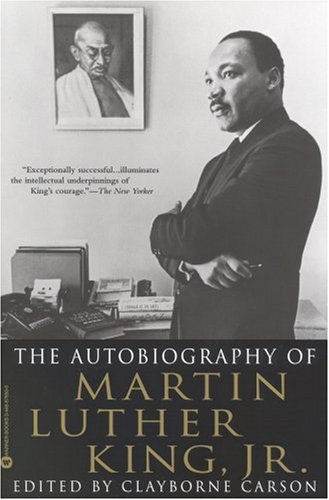
The Autobiography of Martin Luther King, Jr.


Recently, I listened to The Autobiography of Martin Luther King, Jr. on audiotape. Surprisingly, the audiotape recently won a Grammy. Not surprising because of this piece of work, but I didn't know they offered Grammys to audio tapes.

The book won the Grammy because, constantly inserted throughout it, it has audio clips of soul singing and his speeches. I couldn't believe how many speeches they have on record. They had at least partial footage of the following speeches and other recordings:

Letter from Birmingham Jail
Address to SCLC
On Rosa Parks
The Eulogy of the Child Martyrs
Freedom is Demanded by the Oppressed
On the LA Riots
On High School
Remaining Awake through a Great Revelation
On Black Power
Why Jesus Called a Man a Fool
Unfulfilled Dreams
Nobel Peace Prize Speech
On Vietnam
Rediscovering Lost Values
I've Been to the Mountaintop
I Have a Dream
Why I Must March
The Drum Major Instinct

It was really cool to hear about Martin Luther King Jr. from his own personal accounts. I'm surprised I've never even heard that he has such a book; it's so cool that he was able to record his experiences pretty much up until his death.

I think I enjoyed hearing his speeches the most. He would rise up so much energy from the crowd. People would be responding to every line he said, and sometimes they would be cheering and hollering. To see that one man could cause so much response and so much hope is overpowering. It's a beautiful thing. He's very inspiring, and you can tell his intelligence from his writing and his speeches.


And, he was so bold even after so many threats. I knew that he was threatened, but hearing him talk about the many times that his life (and his family's) would be threatened, it's hard to bear. I am impressed that this didn't stop him on his quest. Actually, he would speak openly about it in his speeches (this probably angered his oppressors). You would think that one might avoid the topic to save oneself, but he was on a mission to make change, and he needed his followers to know that they were not going to bring him, or his mission, down.

I think it is inrcredible that he was offered the Nobel Peace Prize while he was still alive and while so much racism was prevalent in our country. What is really crazy is that, very shortly after he accepted the award, he was thrown in prison. Ironic. He's such a legend but our country throws him in prison. He got his message across and out there, but it just shows how outrageous times were in the south during his lifetime.

Additionally, I think it's honorable that Dr. King decided to dedicate his life to improving conditions in the south. After he graduated college, he was able to accept jobs in the north, where he knew his life would be easier, or in the south, where he knew his life would be harder but he could make more change. King chose the harder path to make more of a difference even though it ultimately lead to his premature death. I would definitely say that is honorable.

King writes all the way back to calling his childhood and pretty much up until the time of his death. They end the audiotape with a recording of him talking about death. He got the message across that he didn't fear death and he was ready to accept it. He had a journey on earth, and he had accomplished very much while he was still alive. He got the ball rolling, and change did happen (even though it is very far from ideal today). If anything, he helped instill hope in his people and he did cause some change in legislation.

What I didn't know and I learned is that King was fascinated and inspired by Gandhi. King took many principles of Gandhi's work and incorporated it into his own. It's pretty obvious that he took his passive resistance method, but I was fascinated to learn that. It makes so much sense!

If anyone is at all interested in King, listening to the audiotape was well worth the time. For History teachers out there, import some of his speeches. He talks about his relationship with Malcolm X, his childhood, the SCLC, and many other famous speeches noted above are quite valuable for the classroom.

So, what do you think of The Autobiography of Martin Luther King, Jr?

Sunday, May 17, 2009

SNL Season 34 Finale


Will Ferrell was a perfect guest to finish off an excellent season on Saturday Night Live's 34th season. This season was extraordinarily strong, creating multiple catch phrases, jokes, and sketches that became immediate successes in pop culture. This season finale though lived up to the reputation of its season.

Arguabally, Will Ferrell might be the most successful cast member to come off of SNL. I know that other cast members had much success, but he seems to have built the greatest reputation, almost having cult-like followers, and being an absolute sensation that produces so many films, comedy sketches, and television programs. More than any other cast member, he can make you laugh without him putting in too much time or effort into the delivery or the jokes. He is just a natural.

Being that he is a previous cast member, SNL played up a lot of his old sketches on this finale. They had him do a Harry Carey bit on Weekend Update; they played an old commercial sketch with Chris Parnell where Ferrell played Wade Blasingame, an attorney to put down dogs for heinous crimes; they had him act as President Bush with Darryl Hammond as Dick Cheney; and most importantly, they had him play Alex Trebek on Celebrity Jeopardy. Featured in this Celebrity Jeopardy was Kristen Wiig as Kathie Lee Gifford, Tom Hanks as a stupid version of himself, Darryl Hammond as Sean Connery, and a guest appearance by Norm McDonald as Burt Reynolds. It was absolutely hilarious. The new catch phrase: Catch These Men = Catch the Semen.

Ferrell is always classic when he appears on this show, whether it was meant to be that way or not.

Does anyone know if this is Darryl Hammond's last season on the show? It seemed like he was in the show a lot more this episode than he has been all season. This could be his final farewell after his long commitment to the show.

Other great surprises: Amy Poehler came back to join Seth Meyers on Weekend Update. I wonder how her show will go...

Maya Rudolph made a guest appearance during a funeral sketch where people kept rudely interrupting the speakers. She sang a crazy song around the tune of "America the Beautiful" to sing about Sasquatch.

The best surprise must have been the last scene: Will Ferrell, Darryl Hammond, Kenan Thompson, and Bill Hader all sat around a table at a restaurant. Ferrell went on a singing tangent (accompanied by a band) about some random love affair in Vietnam. (Apparently he was on vacation and the whole dramatic song was kind of silly). Cast members and guests played instruments. All cast members were on stage with an instrument. Tom Hanks, Artie Lang, Paul Rudd, Anne Hathaway, Maya Rudolph, Norm McDonald, and Green Day (the musical guest) came on stage to play their instruments as well. With them all on stage pretending to be goofy, it was an end scene to the season that was absolutely phenomenal. Absolutely astounding.

So what will next season bring? Hopefully more Kristen Wiig. Apparently she has signed on to be on Weekend Update with Seth Meyers. I don't know how I feel about this. I think she's a GREAT leading role for their cast. She really is their strongest member. I don't think she HAS to go there and dominate too. It's like when Amy Poehler did it. She was their strongest member, and then she jumped on that set with Tina Fey and then Seth Meyers. She wasn't the best at her delivery, but she got used to it. It didn't seem to be her strong suit. Just save her for other things.

And I think Seth Meyers does a fabulous job by himself. I think they should have a season or two where they just keep one person doing it alone. That's how it used to be for most of their seasons. It might not be a bad idea, but they can't get enough of Wiig.

If you missed the finale, go to SNL's website and watch some of the video clips. They're worth watching. They're hilarious. Check out some digital shorts while you're at it (specifically the newest one, "Motherlover").

So, what did you think of Season 34's finale on SNL?